

The Oldest Provocation
Ann Widdecombe, Cain and Abel, and the civil war between the sacred and the profane

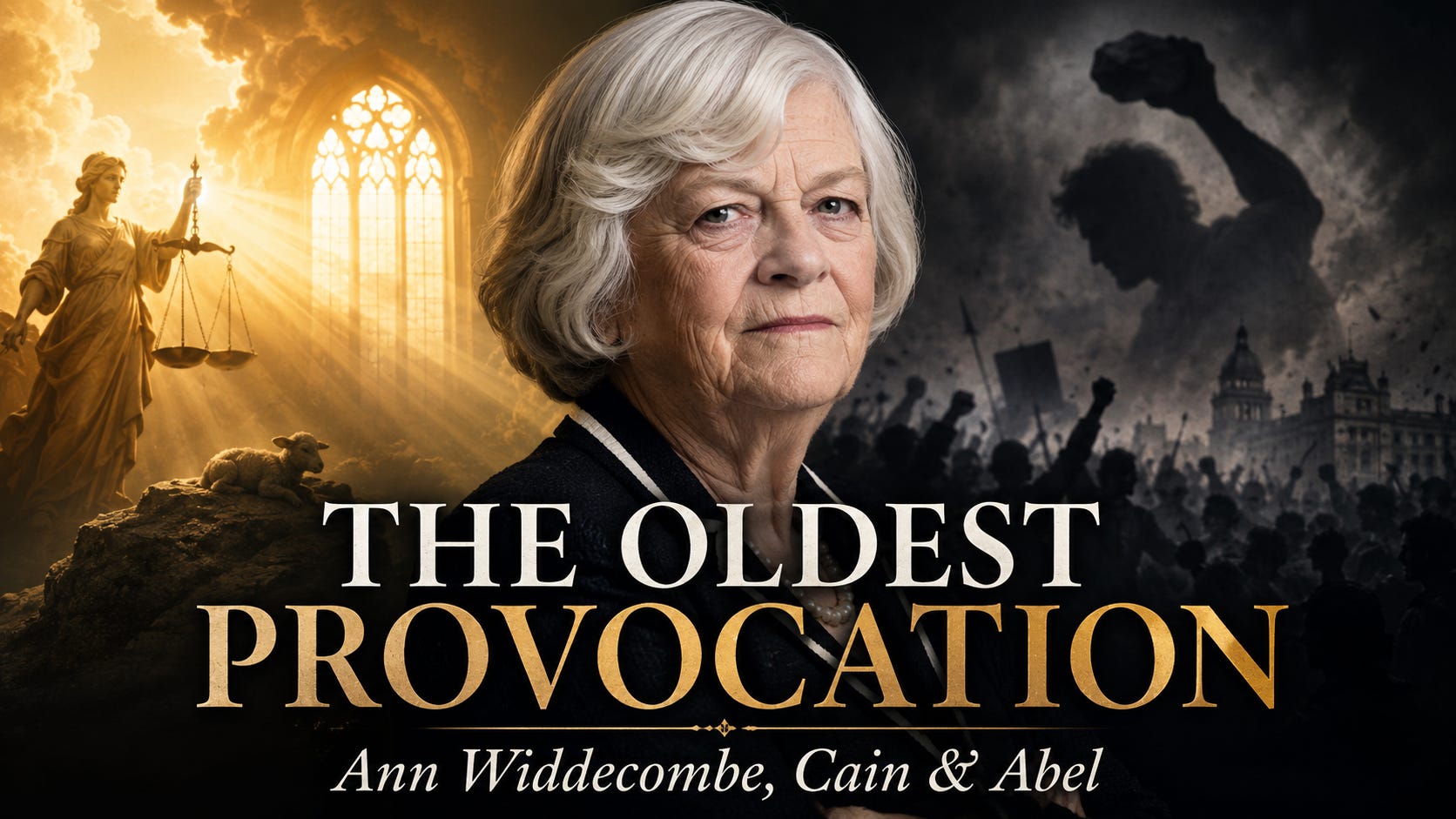
Suspended Animation
After the death of Ann Widdecombe, and before the police complete their investigations into the motives of her murderer, we are living in a strange moment of suspended animation.
We know what is coming, but not quite how it is going to play out.
We are in the middle of a longer period of conflict between the rage-filled, power-hungry progressive Left and the weakened pillars of post-Christian civilisation. At stake are freedom of speech, freedom of conscience, and a disputed anthropology.
The contested philosophical question is whether a man needs saving from himself by God, or can save himself by the exercise of political power and the punishment of those who dissent.
The matter has been complicated by the behaviour of the police. The glue of social cohesion, which trust in the police has provided, has been tragically eroded one step further.
We have no explanation as to why they would want to tell the public things that were self-evidently untrue—“there is no evidence of a political motive”—unless they were invested in depriving the public of information that would have made it anxious and outraged.
But in one sense, there are some of us who believed we did not need to wait for what the police are going to tell us about the motivation of the murderer.
We don’t need to wait, not because we’re impatient, but because we already know the answer.
We Already Know the Motive
One of the most extraordinary phenomena that followed Ann’s death was the outpouring of rage, hatred, vitriol and schadenfreude in the public square.
There was a time when a public death led to an amnesty of moral judgement on a person’s life. Instead, the dead were treated with respect, consideration and mourning. Criticism and, to some extent, condemnation were suspended, at least for a while. That period of decency, which was essentially part of Christian culture, has passed.
Peter Tatchell, for example, took to X to mark her passing by rehearsing her opposition to gay law reform and, as her final epitaph, shouted in capital letters: “BIGOT.”
On Sky News, Adam Boulton could find nothing to say of her contribution to the political, cultural and moral life of our country apart from the fact that she was an old maid who hadn’t had sex.
On Bluesky, an entire chorus struck up its version of “Ding-Dong! The Witch Is Dead”, collapsing a life in Parliament, of public service, of generous entertainment, inspirational humour and moral courage into one single repetition of the disqualifying word: “bigot”—as though the label, once nailed on to her memory, licensed their glee.
This outpouring of jeering and poisonous condemnation was not restricted to the fringe of society. As Andrew Doyle observed, the voices were not those of crazed activists, but recognisable, ordinary people—comedians, actors and representatives of mainstream opinion whom you would expect to know better.
Jo Bartosch, the Assistant Editor of The Critic, named the mechanism with clarity: the opponent is put in the public stocks and stripped of their humanity, so that they can be safely and legitimately despised. This stripping of humanity seems to be an extension of the urge to engage in desacralisation, which we will come to below.
Where can we find an archetypal theological pattern that helps us understand this civil war in society between hatred and kindness, between dehumanisation and respect?
Cain and Abel in Genesis: A Study in Resentment
The story of Cain and Abel in Genesis gives us both a psychological and a spiritual template for the way in which anger, rage and, above all, resentment break out in both families and society.
In the amphitheatre of free will, where all of us face the moral test of how we react to goodness, Cain and Abel is a study in resentment. Although he was not told why, Cain decides to react to the fact that Abel’s gift is accepted while his is not with resentment, rage and grievance.
Christ’s narrative and gift of redemption are an exploration and a healing of the dynamics of this fracture. It looks as though the real object of Cain’s rage is, in fact, against God for being unfair. God in the Incarnation will present himself to face that rage, receive it, absorb it, and redeem it.
Cain could not endure a goodness he had not authored. This is the archetype we find recurring throughout history: the good provokes, the good indicts, and the wounded self reaches for the stone. It begins with hatred and often ends in murder. Its impulse and effect will be undone, finally, only by the Incarnation.
Resentment, bitterness and self-pity are redirected away from God, who is inaccessible to Cain, towards the brother and neighbour who are accessible. The rage is transferred into the rock, and the anger in the heart that Jesus warned could become murder does become murder.
In his homily on Cain and Abel, St Basil defines envy as “distress caused by your neighbour’s prosperity.” The jealous soul is never free from anguish. But the sentence that offers us a profound moral diagnosis that explains something of what we see in and around us is his observation that Cain, unable to strike at God, turned his vengeance upon Abel because God had seen, recognised and received the good in Abel’s heart.
Basil calls Cain “the devil’s first disciple”, learning from him both envy and murder. That hands us the spiritual lineage explicitly: the satanic original, the human copy, the same movement of the will against a good it cannot author and cannot forgive.
This dynamic, compressed into a few words, is this: envy is an implicit accusation against God. Cain cannot reach God, so he transfers the blow to the person who has received God’s favour. It’s all driven by self-pity, resentment and envy.
When Cain decides to attack his brother because God is unreasonable, he engages in something we might call a process of desacralisation.
In order to disguise his rage against God, he attacks God’s proxy. And this is another pattern that we are going to see repeated time and time again.
If Cain and Abel offer the theological archetype, the political archetype may be seen most clearly in the French Revolution.
The French Revolution
The French Revolution was the explosion of secular ambition, resentment and rage into European history.
The last time this fury reached such a pitch, it was with the birth of the French Revolution.
Again, the engine was resentment; and again, the method was desacralisation.
One might say that the resentment and envy that began in a field end on a scaffold. Cain at least buried his brother in silence; he knew enough to be ashamed. But the Terror had outgrown the shame and learned to kill in daylight and call it virtue. What the field concealed, the Revolution paraded, for it had discovered how to justify and legitimise the blade. The crouching sin of Genesis had, by 1793, been given civic robes, a rhetoric and a committee.
The desacralisation was driven by a determined conviction that human beings could improve themselves and did not need God to do it. What was required to do it was more law, opportunity, resources and punishment—and then murder—for those who refused.
It is always striking the way in which the Left finds those who say their prayers and make an offering to God, like Abel, to be the source of profound provocation. The response is always resentment and, often ultimately, their killing.
The French Revolution is the reiteration of an ancient dream: the pursuit of the perfection of humanity by power and punishment, purchased with somebody else’s blood.
In the French Revolution, the progressives found those who bent the knee to God and pursued holiness and virtue to be a provocation of the deepest kind. And, as so often when the Left attempts its bloodbath of desacralisation, its first targets become those who speak out publicly on God’s behalf.
For example, from 1790, in Paris, after demanding an oath subordinating the Church to the State, those who refused this bid for control were first punished and then murdered.
In the September Massacres of 1792, more than 200 priests and three bishops were murdered in Paris. At Nantes, priests were bound together and drowned in what were mockingly called “Republican marriages.”
In July 1794, the sixteen Carmelite nuns of Compiègne went to the guillotine in the Place de la Nation, singing the Veni Creator as they climbed the steps to their deaths.
Why are the progressives driven to such a state of “enragement” by those who seek virtue and dedicate their will and heart to God?
Because what seems to have enraged the progressive secular Left in this country most about Ann Widdecombe was her belief in God and her public defence of His moral universe.
The same resentment that expressed itself in the killing of those who gave their lives rather than surrender to the desacralisation of society lies behind the murders that followed: both those of the nuns of Compiègne and the murder of Ann Widdecombe.
The Oldest Provocation There Is
And so we return to the strange, suspended moment in which we began.
