

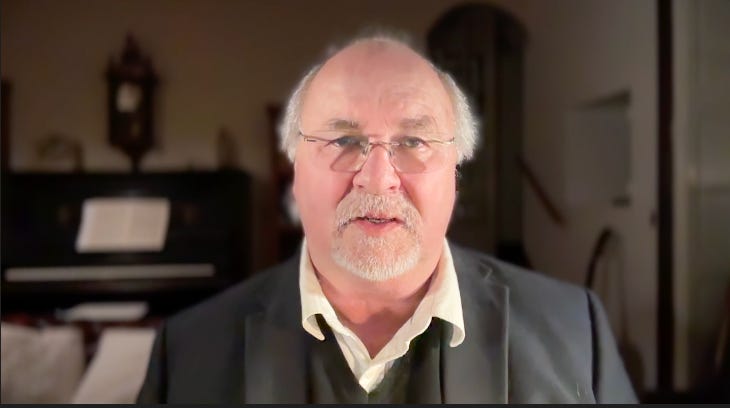
A few days ago, I was asked to give a speech in the House of Lords to the Cambridge Conservative Association. There have been a number of requests to reproduce it so that it can be accessed here. For subscribers, a video of the reconstructed speech is included at the bottom of the article.
“My Lords, ladies and gentlemen —
It is a great privilege to speak to you.
My father was a member of this association after the war. He came up to Cambridge to read Law, having spent four years on the North Sea convoys fighting totalitarianism. He would, I think, have been pleased that you invited me here tonight.
And I am grateful.
But I am also uneasy.
Because I have the growing suspicion that we may not be gathering at the beginning of a political renewal, but somewhere near the end of one.
There is a possibility — one that would have sounded melodramatic not long ago — that conservatism in Britain, and perhaps across the West, is ceasing to exist as a meaningful political and cultural option.
The Long March
If the long march through the institutions has succeeded to the extent that it appears to have done, then we face a strange predicament.
We are being asked to conserve institutions that have already been captured.
And if you conserve institutions that are ideologically hostile to you, what are you actually conserving?
At some point, conservation becomes assistance.
Education.
The law.
Medicine.
The arts.
The professions.
The armed forces.
Even — God help us — the Church.
If these are already settled in one ideological direction, then there is, strictly speaking, nothing left to conserve.
And that raises an awkward question.
If there is nothing left to conserve, what is the conservative for?
Let me share something personal to illustrate what is coming upon us.
The Unlooked for Gift of Martyrdom.
For ten years I was a chaplain to the Queen. Part of that office involved preaching annually at the Chapel Royal in St James’s Palace.
On one occasion I received a call from the Lord Chamberlain’s office.
“You cannot come.”
Security services had intercepted credible Islamist chatter proposing my assassination at the next service. MI5 required that I be stood down.
I said I intended to go. It was my duty. Risk accompanies office.
I may have added — somewhat mischievously — that martyrdom might shorten my time in purgatory.
They consulted the Queen.
The reply came back: you cannot attend.
One palace official told me — with devastating English understatement — that Her Majesty was not prepared to pay to have my blood removed from the carpet.
Whether those were precisely her words, I cannot confirm. But I did not preach that year.
When I next went, I was escorted across the small road dividing the palace buildings under armed guard.
The chatter had not entirely ceased.
That episode clarified something for me.
We are no longer dealing merely with national disagreements. We are living in an age where the globe has shrunk. Immigration, communication, demographic change — these mean that we are facing the collision of worldviews.
Not policies.
Worldviews.
Soviet Utopianism
In the 1980s, I smuggled Bibles into the Soviet Union.
I did so because friends had witnessed churches bulldozed and Christians silenced. The regime claimed tolerance. The reality was eradication.
On one trip I was arrested at Moscow airport.
Two KGB officers interrogated me. One was a major. He looked extraordinarily like a young Vladimir Putin — who at that time was indeed a KGB major in Moscow. I cannot prove it was him. But the resemblance was unnerving.
They threatened me with twenty years in the gulag for “bullion smuggling” — my wedding ring being classified as undeclared gold.
They offered me a year off my sentence for every name I would give them.
They alternated menace with psychological manipulation.
I was eventually released without cooperating. I was tailed instead. The release was something of a miracle and provides a different and additional story.
But I left with a clear understanding of something: secular utopianism is not theoretical. It imprisons, tortures, coerces and kills.
The death toll of twentieth-century Marxist regimes exceeds one hundred million.
We congratulated ourselves in 1989 that history had ended. But the ideology did not disappear. It changed costume.
The mechanisms of social coercion — of silencing, cancelling, excluding — have reappeared in softer forms.
And one constant remains.
Whenever the utopian Left acquires power, one of its first enemies is Christianity.
Russia.
Spain.
China.
The Christian worldview is always treated as a rival.
That should tell us something.
But there is another pressure.
The Islamic Future
A number of years ago, about the year 2000, while running interfaith seminars at a university, I hosted a respected imam. He was ab academic I had worked closely with for years.
As the event concluded, he told me calmly that his task in Britain was complete.
He had arrived in the 1970s, he said, with the aim of inaugurating an Islamic Republic of Great Britain. He had succeeded.
The demogaphics would shape an Islamic future through the democratic process.
In several northern conurbations, Muslim populations under sixteen were already majorities. In time, democratic mechanisms would yield Islamic mayors, Islamic Sharia law in practice, perhaps partitioned regions.
I checked the numbers.
The trajectory was real.
This was before migration accelerated further.
Across Europe, similar patterns are visible. And not abstractly. Forty miles from my own home in Normandy, Father Jacques Hamel was murdered at the altar.
This is not rhetoric.
It is reality.
So we face two pressures.
Secular utopianism.
Religious theocracy.
They appear opposed.
In fact, they share something.
Both are collectivist.
Both subordinate the individual to a grand abstraction.
Both promise a shortcut to paradise.
And both tend toward absolutism.
So what stands against them?
For much of my life, to advocate a Christian worldview sounded tribal — as though one were simply cheering for one’s own team.
That is no longer the situation.
Catholic Anthropology
The question now is anthropological before it is theological.
