
SUPPING WITH THE DEVIL - NEEDS A LONG SPOON; - The day I was first accused of being a murderer.
On faith, media, and the perils of engaging with the enemy - with a 'thank you' for your support.

The Canterbury Graffiti Debacle
The Canterbury graffiti debacle is still rumbling on. When I woke this morning I found my earlier article here had been quoted by another news outlet. There's always that moment if you wait to discover whether or not, they've quoted you accurately and sympathetically, or something rather worse. Luckily, on this occasion, it was accurate and sympathetic, and I was grateful; it doesn’t always happen. It reminded me how difficult it is to get a fair hearing from the mainstream media.
Obviously, what Elon Musk has done through X is indescribably important and something for which we can all be eternally grateful. But Substack is highly significant as well, and part of the purpose of writing this reflective essay is to thank you for your support and explain, at least from my point of view, with a rather more personal touch than usual, why it matters so much.
A few days ago, BBC Radio 4 phoned me and asked me to join in a public debate about the graffiti. For most of the last few decades, I would have been delighted to have the platform of Radio 4 on the BBC. It’s the serious channel where things get taken up, and you get listened to by the movers, shakers, and lawmakers. But things have seriously changed.
I was billed to be in discussion with a gifted Anglican priest who worked full-time as a psychiatrist and was just a priest at the weekend. He was a well-known “alphabet activist.” A clever man. Worth debating, but not to be underestimated.
The interview with the editor, in preparation for going live on the debate, took about an hour. I was pressed hard on my views, which is fine by me. I don’t mind articulating them, and I’m always pleased to have them represented properly.
But then alarm bells began to ring. I was suddenly asked what I thought about JD Vance and Elon Musk weighing in on the discussion. That wasn’t so bad. It was when they brought in Tommy Robinson that I realised things had changed — and were about to change a great deal for the worse. It's true that Tommy Robinson had a tweet commenting on it, but along with literally millions of other people. Why should they quote him? Why should he suddenly be introduced into the conversation?
And ‘worse’ happened quite quickly. I was suddenly asked my views on “white supremacy.”
How on earth we’d got from an incompetent, alphabet-driven Dean commissioning trans-activist graffiti artists to vandalise one of the most beautiful buildings in the world, to white supremacy, wasn’t clear to me. But I quickly realised what traps were going to be set.
I was very happy — in fact, I was glad to have the platform to talk about beauty, truth, art, and God, and the relationship of Catholicism to all of them. But I realised I was about to be smeared with a whole load of other culturally immoral labels — ending up, if I was lucky, with “white supremacist.”
I decided to pull out of the programme. I think it’s the first time I’ve ever done something like that, and I wondered whether it was the right, courageous, and sensible action. As you can imagine, I listened to the programme with interest when they replaced me.
In fact, they replaced me with someone far more articulate — a historian and author called Bijan Omrani.
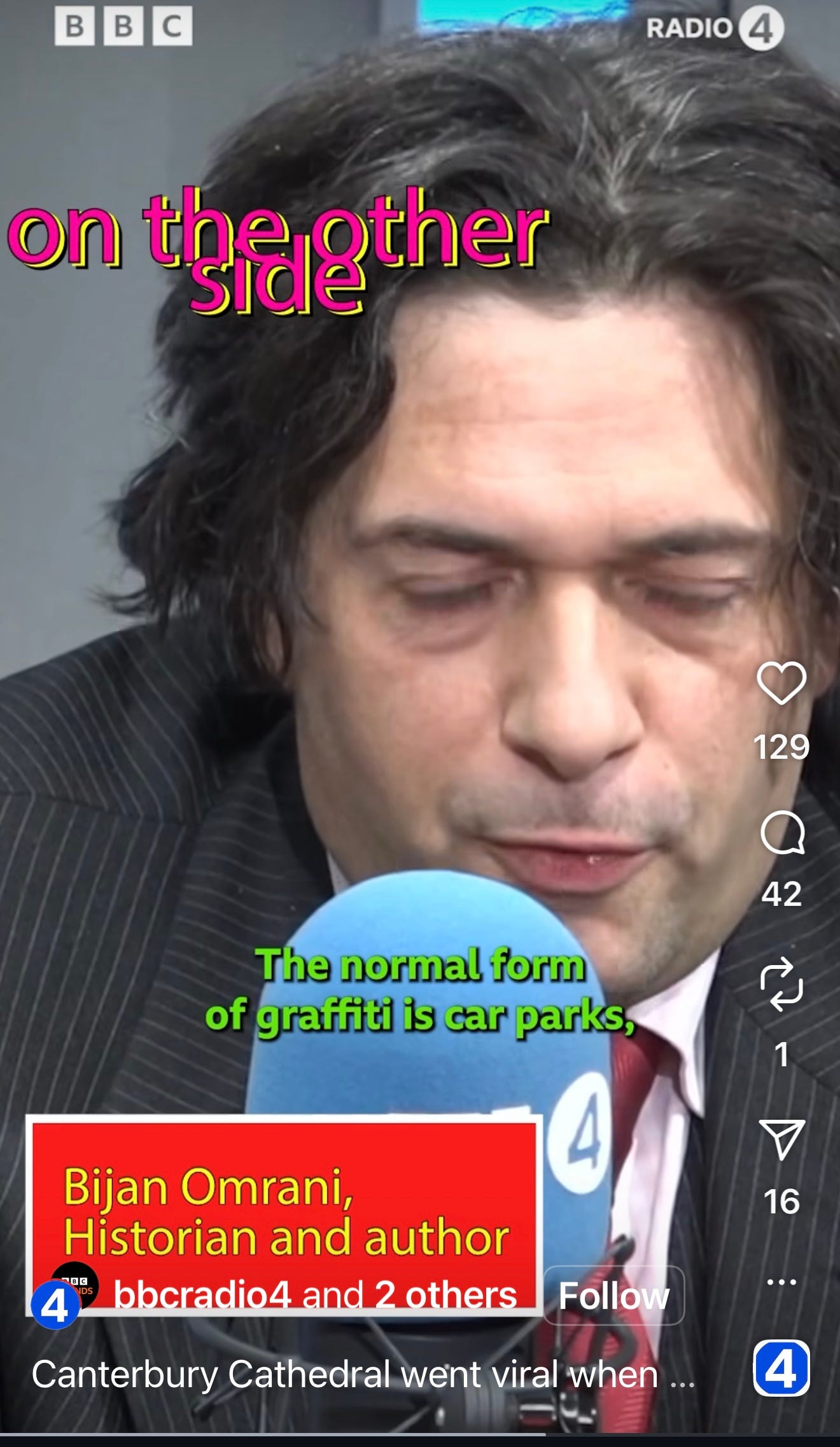
He’s not entirely white, and he’s an immigrant, so he picked up a few progressive “kudos points” that I would have completely lacked. Of my qualifications for doing this, I write and think about the subject — but I also happened to grow up around the cathedral.
As a boy, I was sent to school there. The cathedral stands at the centre of it — or rather, the school was built around the cathedral. The school’s been there since 597. It began as a place for training monks and carried on that way for a thousand years, until the Reformation.
I was cheering him on as I listened from the sidelines, wondering how they’d try to trap him — since they couldn’t do it with “white supremacy.” The trap came soon enough. Charlie Bell played the alphabet trump card — the one they always play, and for which there’s no really safe answer.
He spoke about the value of representing the marginalised and the dispossessed, since the artist was a trans activist. Then he accused Bijan of being part of a bourgeois hetero “aesthetic response,” the effect of which, he said, was to kill gay people — because if you increase their marginalisation, if you reject their claim to impose their agenda on society and exclude anyone who doesn’t agree, the effect is that “they commit suicide,” we are told. Your views make you a murderer, is the implication.
Undoubtedly, alphabet and trans people take their own lives in the same tragic way that straight people do — but it’s a correlation–causation issue. There’s no evidence that the beliefs of a heterodox society are directly responsible for people who don’t fit in killing themselves. But that’s the accusation.
Because there’s no evidence, you can’t refute it — and if you can’t refute it, they’ve got you. You’re a killer.
