



There are some moments in the life of the papacy that one never forgets.
Even as a non-Catholic, I remember Saint John Paul II dropping to his knees and kissing the ground as he came down from an aeroplane.
I think the visit of Pope Leo XIV to France will become one of these visits, engraved in the memory and sinking somewhere deeper into the heart and the soul.
No one knew quite what to expect of what might have been just a diplomatic visit of a fairly ordinary kind, but it seems almost to have had the capacity of lighting the touch-paper of faith and hope, in the competitive context of this moment in European history, when Catholicism and secularism are fighting over the scraps of a dying culture.
A Catholic Capture of Paris
It wasn’t just the images which were extraordinary.
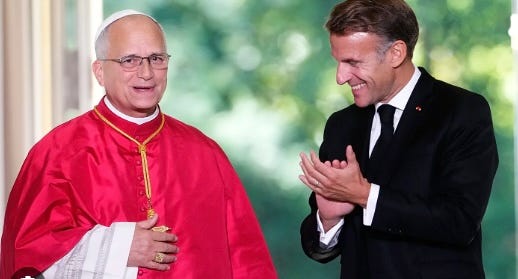
They ranged from the Pope giving a lecture to the President of France, in which he advised him in no uncertain terms to respond to the reciprocal interest of the Church in the state, with an interest of the state in the Church.
They continued to scenes of him travelling through Paris, a kind of Catholic capture of the city, by which those who have conquered Paris have announced their presence.
Whoever wants to capture Paris seems to have to make a triumphal procession through it, and when Leo set out on that journey, the numbers of people in the images that accompanied him were quite extraordinary.
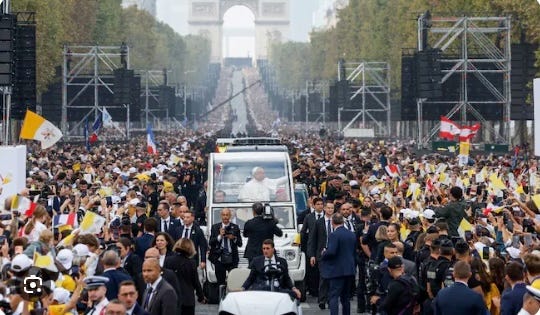
It wasn’t just the numbers, and the way in which the crowd reached out to him and he responded to them.
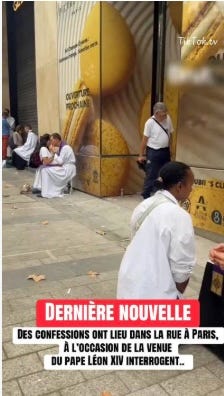
It was the scenes of priests sitting on doorsteps down the Champs-Élysées, hearing confession after confession after confession.
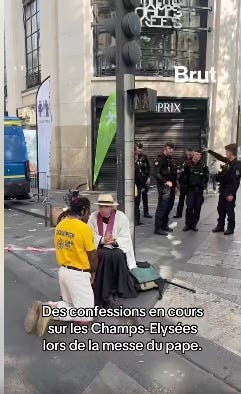
The sight of people turning this central artery of Paris into a grand confessional, where they sought reconciliation with the Church and absolution of their sins, was remarkable.
Confronting the Spirit of the Age
If this wasn’t an exciting, dramatic and significant enough beginning, then the stages of this four-day visit developed into a strategic confrontation with the spirit of the age, in which the Pope found a platform for confronting the dehumanising consequences of secularism.
The Pope quite rightly chose his theological battleground with care, and it was about anthropology.
It was about the competing and partly conflicting ideological understandings of the nature of humanity: what it is for, and what it /we can never be reduced to.
He had some advantage in the historical context, as in the 233 years since the guillotine killed so many of those who stood faithful to the Catholic Church, it could be argued that an experiment in secularism had taken place.
But we know something of the results of that experiment now.
We know that the total of human happiness has gone down, not up, especially if we measure it in the drug-ridden, narcotic-dependent despair of younger generations suffering from levels of mental distress almost unique in the records of our culture.
The Pope made a point of talking about the way in which Christianity, and Catholicism in particular, take a completely different value system to their heart.
Marie-Garance: “This Is Catholicism”
Perhaps no image summed it up more than when he held in his arms a disabled 11-year-old girl who had been brought to Paris to be close to the Holy Father.
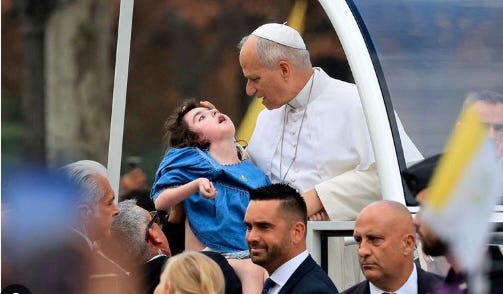
Let’s take a moment to follow the human story.
It may be that few have gone beyond the picture to encounter Clotilde and Nicolas Noël.
But we can.
Social media recounted the story:
“Pope Leo XIV blessed an 11-year-old girl named Marie-Garance on the Champs-Élysées last Saturday, and the photo of that moment has now travelled around the world.
The first American pope was riding the popemobile down the famous avenue, about 1.2 miles (2 kilometres) from the Arc de Triomphe to Place de la Concorde, where he celebrated an open-air Mass. The Vatican estimated the crowd at 800,000 people.
Marie-Garance, who lives with severe multiple disabilities, was waiting with her mother and her little sister Pépa in an area reserved for wheelchair users.
The meeting was never planned. People around them began saying the Pope had to see these two little girls. Marie-Garance was passed from hand to hand through the crowd, and a Vatican gendarme lifted her up to him. The Pope traced a small cross on her forehead with his finger. Pépa was blessed too.
Her story makes the image even more powerful. Marie-Garance was once a ward of the French state. Her birth parents could not manage the heavy medical care she needed. In 2016, when she was 16 months old, she was welcomed by Clotilde and Nicolas Noël, parents of ten children.
Four of them were adopted, and all four live with disabilities.
Speaking on French TV, her mother said she felt a shiver run through the crowd, like a moment suspended in time. She also said people around them were happy and thanked the family afterward.”
This is Catholicism.
In a society which is becoming increasingly careless of the fragility of human life, this act of tenderness and genuine inclusion became an icon of Jesus, embodied in the kind attention of the Pope himself.
But, for those who subsequently met Clotilde and Nicolas Noël, the story deepened.
This was caritas; this was accompaniment; this was Catholicism.
Replacing the Stale Memory of the Olympics
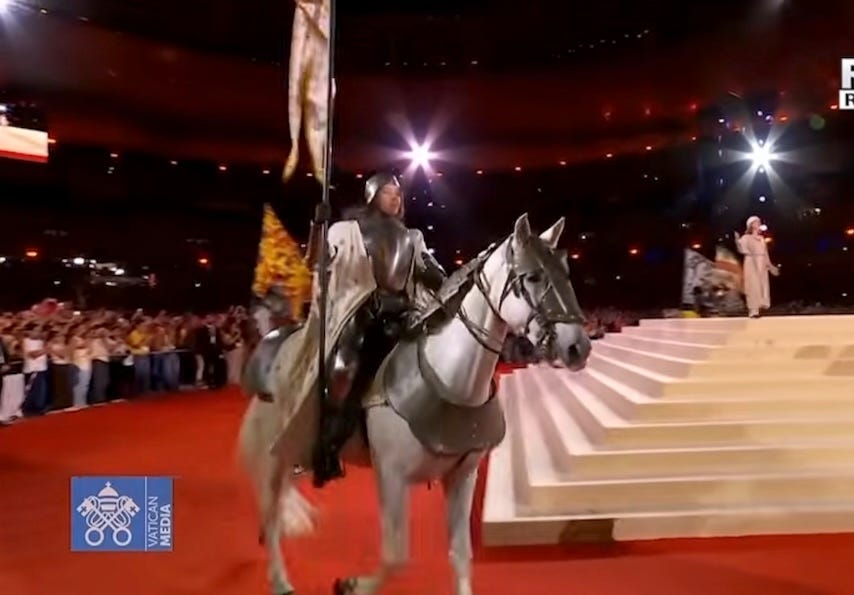
For those who saw the tableau of the history of Catholic France, and especially the wonderful imagery of St Jeanne d’Arc, the evening ceremony was vividly inspiring.
The image of Joan of Arc, the standard of France, and the beauty of singing and dancing, poetry, narrative and culture, stood as a direct rebuke and contrast to the grotesque decadence of the opening of the Olympic ceremony.
Each stage of his visit was a Catholic-constructed argument that confronted the secular enemy and, having exposed its inadequacy, offered a carefully thought-out, concise and rather beautiful expression of the consequences of Christian anthropology.
AI, Technology and the Human Person
At the Élysée and UNESCO, he framed technology and AI as testing our understanding of what our humanity was for.
Machines get called intelligent while people are measured only by productivity, he said, and then, of course, when they don’t measure up, the people are discarded.
He made this insight concrete.
He expanded its implications fully as he confronted the recently legalised practice of assisted dying in the French state.
He undermined the legitimacy of the state’s attempt to attach morality to its laws by saying that legality does not make anything moral.
He encouraged, for obvious reasons, care and palliative medicine, and spoke to all those who suffered by telling them, in the name of Christ, that they are not a burden weighing down their loved ones.
Rather than simply offering a philosophical argument, he grounded it theologically.
He spoke not about autonomy or usefulness, the tradecraft of secular humanism, but instead reminded everyone listening to him that each person is personally willed and loved by God.
The phrases he used on his journey will find themselves repeated time and again by Christian apologists.
He spoke of people whose lives are judged by efficiency and who, when they are no longer productive, are rejected and discarded.
He continued: “Our dignity is not destroyed by illness or suffering.”
At Lourdes, he said that it is impossible to consider causing death as normal.
And once again: “What is legal is not necessarily moral.”
Medicine must never become the servant of programmed death.
In case the message had never got through, he went on to tell the sick that they were not a burden, but “the beating heart of our humanity” and “a precious treasure for the Church.”
The Treasure of the Church
Those with a sense of Church history will remember the confrontation between the deacon Lawrence in Rome and the rapacious secular state looking to steal the Church’s wealth.
Lawrence presented it with the sick, the lame and the poor, and said to the state: these are our treasure.
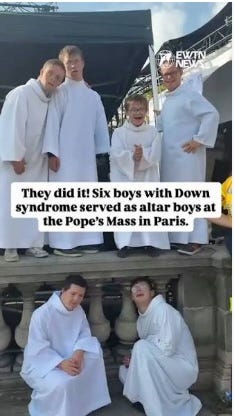
At each of the four stages of the journey, Leo made the case for replacing the anthropology of secularism with the teaching of Christ.
He said that if we were to avoid losing our humanity amid a “paradise of machines” invading and conditioning our daily lives, there was an urgent need for education in ethical discernment.
The AI industry is not providing this ethical discernment.
In fact, it’s doing almost the opposite, rushing headlong with the seemingly unstoppable momentum of technology, without sufficient reflection or safeguards.
It is the Church that is providing the caution and the capacity for measuring the value of humanity, against the dangers of the new technology.
He said with succinct clarity that the purpose of the Church in addressing and confronting AI, was to make the human person once more the focal point of reflection.
What is the reason for this?
It is because this is connected with unconditional respect for our interior freedom and sacred dignity.
What Does “Dignity” Mean?
The word dignity has energised people into a conflict that is, at first sight, unnecessary, but perhaps one that can help us if we give it some further thought.
The Pope’s friends saw it as a way of offering shorthand for the understanding of the Church drawn from the book of Genesis: that human beings have dignity because they are made in the image and likeness of God.
The Pope’s enemies saw his use of the word dignity as a capitulation to the optics of secularism, which suggest that human beings have dignity because they create it for themselves.
The fact is that a word can have different meanings according to its context and according to the intention of the person who uses it.
Those who suggested the Pope used it in a secularist sense, giving a hostage to secularism, have had their judgement muddied by bitterness and fear arising from the culture wars within Catholicism.
It became perfectly clear throughout everything he said that he was weaving a single web of Catholic teaching, constantly offering a justification for the dignity of human beings as flowing from the mind and love of God, expressing itself in an act of creation that made humanity in his image and likeness.
He said that our dignity was not destroyed by illness or suffering, and did not depend upon our abilities.
This only makes sense if it is fully Christian and not a form of recycled, shallow secular dogma.
In the light of Christ, every person appears to us as a creature willed and loved by God.
It is explicitly in Christ that the dignity the Pope was talking about finds its locus, its full source and expression.
From Anthropology to Civilisation
If the first stages of his visit expressed the importance of Christian anthropology and a philosophy of the person, at Metz he lifted his eyes and began to speak about civilisation.
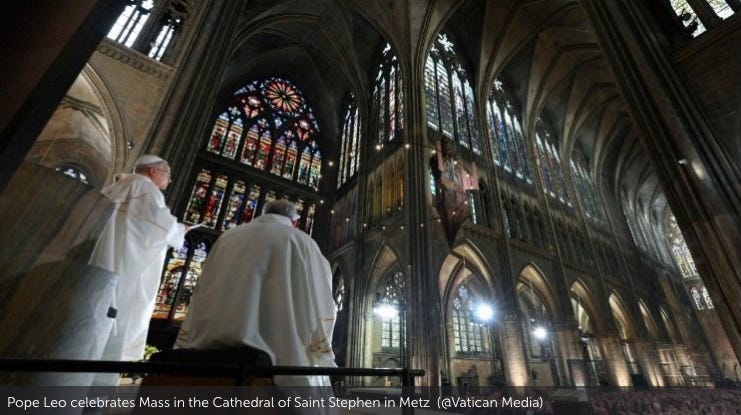
He laid down a manifesto for Christian civilisation.
This is no small matter, since it is exactly Christian civilisation that is at risk from the twin pressures of Marxist utopianism and Islamic authoritarianism.
He described a Christian trajectory that led towards a civilisation that respected human beings and their Creator.
In other words, as part of completing his journey into Christian anthropology, he made the case for saying that human dignity and the recognition of the presence of God cannot ever be separated.
And he circled back to his encounter with President Macron as he described the necessity of a Church and a state in which the Church was not deprived of its responsibility for offering an ethical and metaphysical critique of the state’s aims, and in which the state had no right to turn its back on the Church as if it were self-sufficient and adequate in itself.
He described Europe’s Christian inheritance by reiterating its characteristics: the primacy of the person, the protection of individual freedom and welcoming the stranger.
The Harmony of Differences
In that most beautiful of cathedrals, using the cathedral as a backdrop for the presence of Christianity in a culture, he turned to the metaphor of stained glass.
God’s light, he said, does not erase our unique identities but unites different histories and cultures in a single marvellous mosaic of peace.
And then, challenging the lust for power and the sterility of uniformity, he said that Europe’s future was to be found in the harmony of differences.
It is a matter of profound shame that Europe has been so weakened by baptised Christians fighting and killing each other, and struggling for national autonomy at each other’s expense.
Without going down the road of rebuking our parents, grandparents and great-grandparents, he invited us to reflect upon the ways in which the wounds of our past can become openings through which light shines.
In Paris, the Pope had asked his listeners what they thought humanity was.
At Lourdes, he asked his listeners to consider what a human life is worth when it suffers.
And at Metz, he asked what civilisation follows if we take the answers of Christ and the Church seriously.
The Image of God and the Renewal of Europe
On this extraordinary visit, Leo began with the dignity of the person and ended with the possibility of a renewed civilisation.
A Europe which remembers that man bears the image of God is not one that seeks unity through uniformity, or peace through the suppression of difference.
The generosity of Christ can, if people kneel before the Cross, become what he called at Metz a harmony of differences: a civilisation which wants to respect human beings and their Creator.
This might be misrepresented as a form of collective relativism by those who did not look at the pope’s face, hear his voice ,or weigh his words carefully.
