

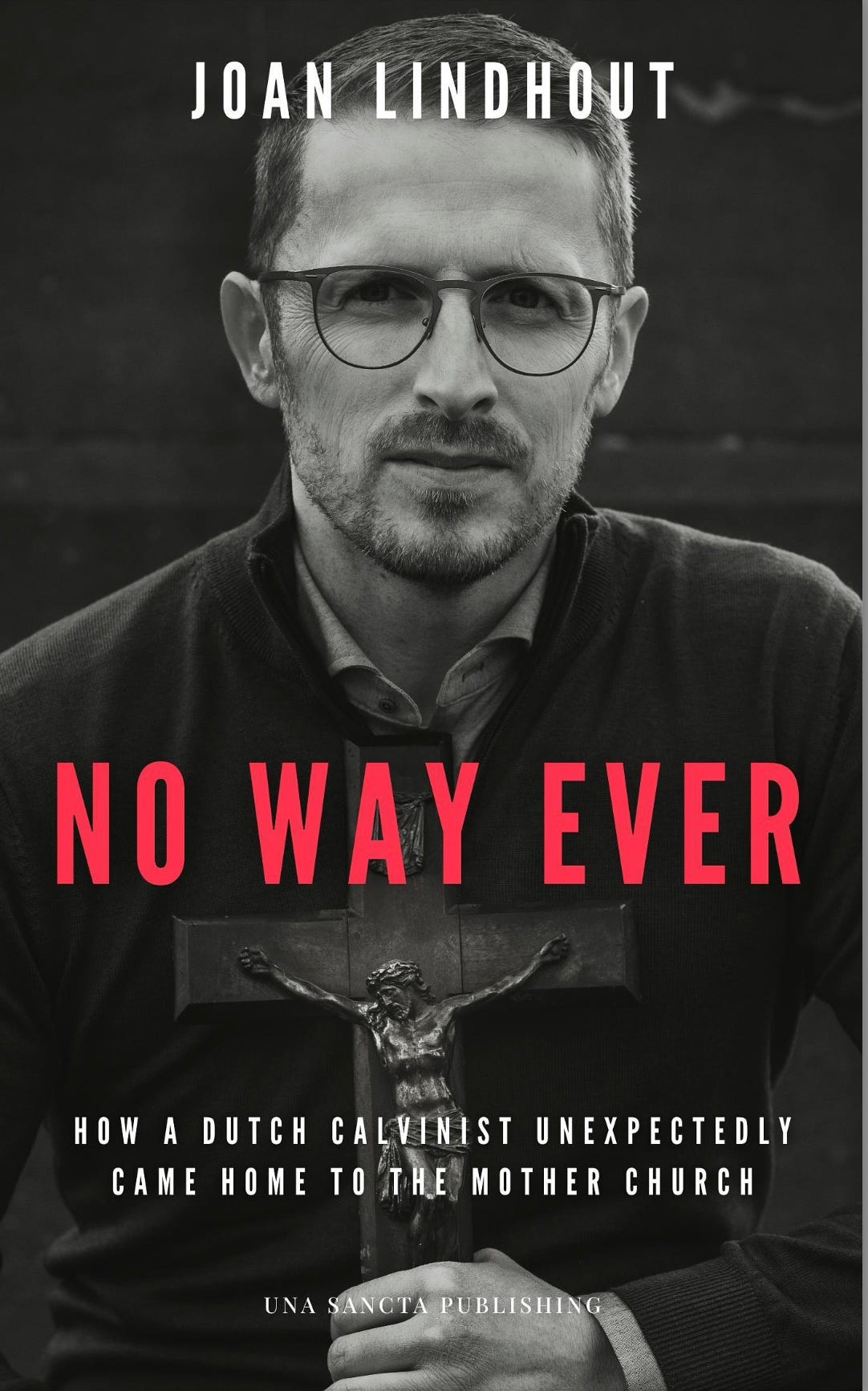
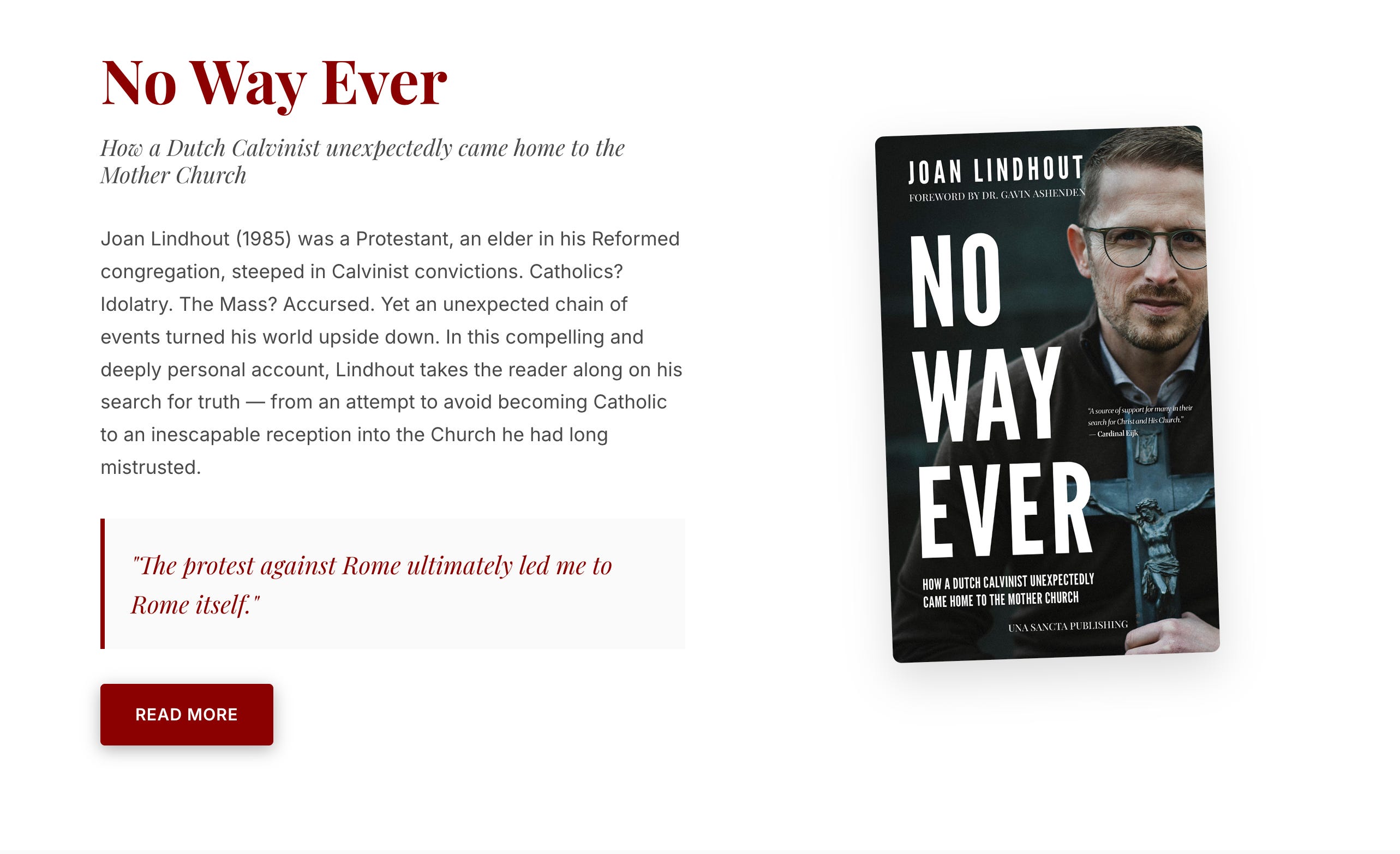
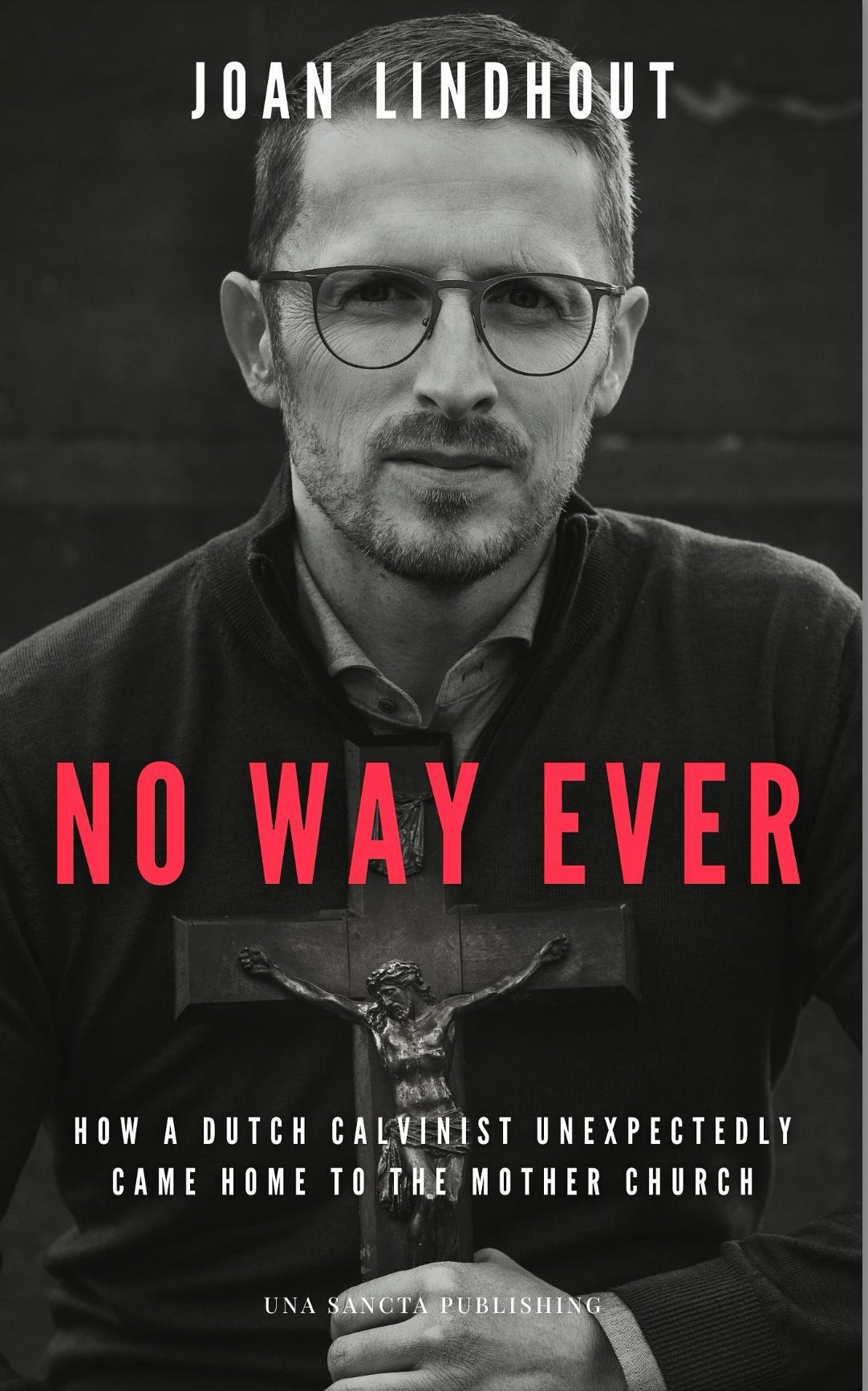
I am publishing (with permission) the foreword and one illustrative chapter -6 -of a new book the Dutch author Joan Lindhout has written on his conversion from Calvinism to the Catholic Church.
Joan asked me to pen this Foreword:
Foreword- by Gavin Ashenden.
I did not know, on the morning of 7 March 2020, that I was about to play any role in someone else’s conversion. I had been invited to speak at a Catholic media organisation in the Netherlands — two lectures, one on Marian apparitions and Eucharistic miracles, the other on the spiritual consequences of Marxism and Islam. It was a Saturday. The coronavirus was already circulating, though none of us yet knew that within days the Netherlands would enter lockdown and the world would change.
In the audience that morning was a man who had come not as a seeker, but as a sceptic. He was there in a professional capacity — to record the lectures on video. He was a ruling elder in the Dutch Reformed Church, deeply rooted in Calvinist conviction, and by his own admission he had recently searched Google for “How not to become Catholic.” He had no intention of being persuaded. He had come armed with the assumption that what I was about to say was either pious nonsense or, at worst, diabolically inspired.
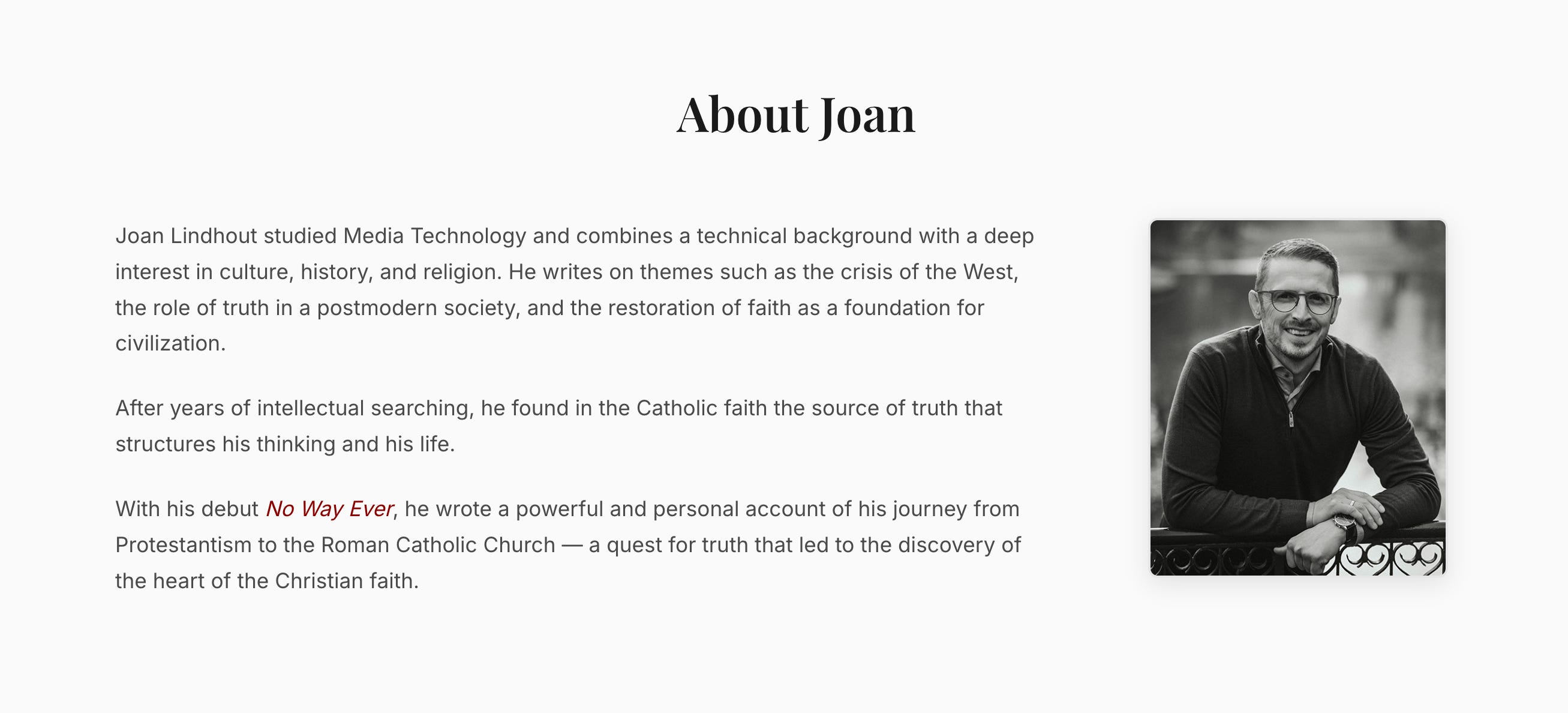
That young man was Joan Lindhout. And the book you are holding is the account of what happened next.
I should say at the outset that I recognise this story from the inside, because in its essential shape it is also my own. I spent years as an Anglican clergyman. I had been a pastor in two parishes, an academic and a university chaplain for almost a quarter of a century, and a broadcaster with my own programme on the BBC. I had run an ecumenical team of chaplains for almost twenty five years, at a leading radical and very much atheist university. I was deeply involved with Catholic colleagues, but also deeply invested in not being a Catholic. However, the same questions that forced their way into Joan’s attention, had been stalking me for decades. Unlike Joan, my response was to ignore them as long as I could. The cost of being found to be wrong was too high. Joan had greater courage and integrity that I did.
What I put a lot of energy into ignoring was the same fault line between Scripture and Tradition. The same discomfort with Protestant fragmentation. The same dawning, unwelcome suspicion that the Reformers had not, in fact, returned to the source, but had fractured the stream. Unlike Joan, I had the comfort of the mis-presentations that Anglicans told themselves in the revisionist history my culture had re-written. Having spent one hundred and fifty years torturing executing Catholic priests who brought the sacrament to those who could not be threatened or terrified out of their fidelity to Jesus, constructed doctrinal statements calling the Mass a ‘blasphemous fable’, celebrating their king as the ‘anti-pope’, the Anglicans then pretended they were a new kind of Christian, a sort of hybrid Catholic/Puritan in a political settlement that was constructed not to reflect the fidelity of the Church, but to avoid civil war and keep those who had grabbed power in power. But to question any of this was to question the state, and the rewards the state gave to those who bought into its narrative. And the rewards were significant. They included my own office which I had held for ten years as ‘Chaplain to the Queen.’ It really was not in my own interests to revisit all the presuppositions of my culture and my ecclesial identity. I had too much to lose. And that is another reason why I found this book so compelling and illuminating. Joan writes it with courage, clarity and a deep and attractive integrity.
When I finally entered the Catholic Church in 2019, I did so — like Joan — not because I was drawn by aesthetics or mysticism, (I enjoyed the stimulus of both, but it had had to be on my own terms,) but because my former position had been broken down and was simply no longer tenable. I could no longer avoid the logic of the truth. It was, as he puts it so exactly, something I could do no other. And, like him and so many others, I had started to read the early Church fathers in their own words. Like him, I was blown away by both by what I found and also by surprise. So much of what I had been taught about the Church had been second hand, filtered through vested interests.
What makes this book remarkable is not merely that a Dutch Calvinist elder crossed the Tiber — though that in itself is striking enough. What is remarkable is the quality of the journey. Joan Lindhout did not convert casually. He objected, investigated, examined and wrestled with what he found. He went back to the primary sources — Augustine, Ignatius, Cyril, Ambrose — and read them with the rigour of a man who genuinely did not want to find what he found. He consulted Luther’s own words on the Eucharist and discovered the extent of the incoherence and contradictions of the competing reformers. He stared in the face the central interpretative tenet of the Reformation; “this is how I read the Bible” and realised that the dominance of the self with its individual lacunae, was a problem, not a solution, to understanding God’s intention, self-disclosure and will.
The central question of this book is one that every Christian who takes their faith seriously must eventually face: where is the Church that Christ founded? Not the church you were born into, or the church your culture handed you, but the one, holy, catholic and apostolic Church to which He promised the gates of hell would never prevail.
This may not prove to be a comfortable question. For many readers of this book, raised — as Joan was — in the confidence that Rome was the problem rather than the answer, it will be profoundly unsettling. I would encourage you not to reach for comfort too quickly.
Joan writes with a clarity and accessibility that is rare in books touching on theology. He does not assume the reader is a scholar. He writes as a man who was himself, not long ago, entirely outside this world — who looked at it with suspicion, and who therefore knows precisely which objections a Protestant reader will bring to the table. He answers those objections not with polemical aggression but with patience, evidence, and a transparent honesty about his own doubts and reversals. The chapters on the Eucharist, on confession, on the Church Fathers, and on the Rosary are particularly fine: each one a small intellectual pilgrimage in itself.
There is also something quietly courageous about this book. Joan knows that it will cost him. Friendships will strain. Some in the community in which he was raised will regard him as a traitor or an apostate. He acknowledges this with equanimity — not because the losses do not matter, but because he has found something so much greater. He has found the source. He has found the living bread. And having found it, he cannot pretend otherwise. More than that. Beign faithful to Christ always leaves us richer in the things that matter. He never leaves us poorer. There is nothing that we sacrifice that we do not receive back a hundred-fold, pressed down, running over.
I want to say something if I may, to any Protestant reader who has picked up this book with either scepticism and, or curiosity.
I understand and sincerely sympathise with that scepticism. I shared it. The resistance to Rome that runs through the Reformed tradition is not merely cultural or historical — it is instilled at the deepest level of religious identity, woven into the way you read Scripture, the way you pray, the way you understand salvation itself.
Nobody should ever be asked to abandon that seriousness, or compromise their integrity. This book is all about integrity. It is a way of allowing oxygen and space to the very questions that integrity demands of us.
We are very simply invited to face with courage (and truth) the question Joan asks: if the Holy Spirit guided the Church for fifteen centuries, at what point did He change His mind?
Can truth contradict itself?
When Calvin and Luther disagreed so fundamentally — on the Eucharist, on predestination, on the nature of the sacraments — who was right? And if both claimed the guidance of the Spirit, and read the Scriptures in contradictory ways, what does that tell us about the integrity of the project?
Why and how did God renew the Church in every single century since Jesus founded it and promised the Holy Spirit to guide and protect it?
Was the profound theology of Thomas Aquinas, the exquisite beauty of the architecture, the power and integrity of the liturgy and its music, the miracles of the saints, the conversion of the powerful pagans of Europe, the ongoing witness of attested miracles, the impact of holiness and self-giving, the passionate love and devotion to Jesus, all the product of theological and spiritual corruption so ruined that the whole edifice had to be destroyed, abandoned and fifteen hundred years after Jesus commissioned Peter, to be started again?
These are not rhetorical questions. They are the very questions that confronted Joan’s inherited assumptions, by which he found himself kneeling at the altar and receiving what the Church has always, from the beginning, called the Body of Christ; called also ‘the medicine of immortality by St Ignatius of Antioch, a disciple of the Apostles, in AD 107.
I count it a sincere privilege to have played some small part in the beginning of that journey. I count it a greater privilege to commend this book to you now. Please dignify both the book and your own soul and well-being, with giving what has been written here, the care and the prayer a journey of this seriousness requires. And do not be surprised if, by the end, you find yourself asking the same questions Joan asked; and having invoked the Holy Spirit, finding yourself travelling, in the same direction.
“He cannot have God for his Father who has not the Church for his Mother.”
St. Cyprian of Carthage (c. 251)
Dr. Gavin Ashenden
—
Prologue
“If then the Church can err, O Calvin, O Luther, to whom shall I have recourse in my difficulties? To the Scripture, say they. But what shall I, poor man, do, for it is precisely about the Scripture that my difficulty lies. I am not in doubt whether I must believe the Scripture or not, for who knows not that it is the Word of Truth? What keeps me in anxiety is the understanding of this Scripture, is the conclusions to be drawn from it, which are innumerable and diverse and opposite on the same subject, and everybody takes his view, one this, another that, though out of all there is but one which is sound. Ah, who will give me to know the good amongst so many bad?”1
— St. Francis de Sales
“December 1594. Snow settled on the bare branches of a winter forest where a young priest was in hiding. He was not yet thirty— newly ordained, yet already burning with a love for the truth. In the region of Chablais, just across the border from Geneva, more than seventy thousand people had turned their backs on Rome. They had embraced the teachings of Calvin, the reformer who called Rome a whore, the pope the Antichrist, and the Mass an abomination.
St. Francis de Sales went alone. No army. No money. No backing from princes. Only his pen—and an unshakable conviction that the truth he served could not be destroyed. Rather than debating in the streets, he put his pen to paper. Letters. Pamphlets. Each morning he slipped them under the doors of people who refused to receive him. They would not listen to his sermons, but they could not avoid his words. And within those words lay a question that still cuts through my thinking like a blade: did the Holy Spirit ever change His mind? Did He reject in Luther what He affirmed in Calvin—or what Rome had faithfully preserved for centuries? Can truth contradict itself? How could two reformers, each convinced they were guided by the Holy Spirit, oppose one another so fiercely on the very essence of the Faith?
The Reformation is often presented as a liberation—as though the darkness of Rome gave way to the light of Scripture. But what if the opposite were true? What if no new light broke through at all, but instead the light was scattered, fractured into a thousand different directions?
I wrote this book as a man seized by those questions. As someone who stood firmly within the world of the Reformation and who slowly—reluctantly—began to wonder whether the Reformation was truly a return to the source, or rather a break with the current that began in Jerusalem, flowed through Antioch, and found its seat in Rome.
St. Francis de Sales did not write to provoke, but to save souls. He spoke with the tenderness of a shepherd and the precision of a sword. And even now, his words still press upon the reader with the same force: truth is not neutral. It demands an answer. A question every Christian, in every age, must face: what if Rome does not need to return to the truth—but I do?
This book is the record of my search. A search for truth, for unity, for the Church that is one in faith, in sacrament, and in apostolic authority—as she has been from the beginning.
I arrived at the same conclusion as the 70,000 people of Chablais, who—save a handful—returned to the Mother Church. The Bride of Christ, founded upon a rock, against which even the gates of hell cannot prevail.
Joan Lindhout, July 2025
1 François de Sales, Les Controverses (Lyon: Jean Pillehotte, 1596); English translation: The Catholic Controversy: A Defense of the Faith, TAN Books (Charlotte, NC: TAN Books, 1986), Chapter 12.
CHAPTER 6. ‘The Divide.
“There will be a translation into Dutch near the back, so if suddenly people begin to shift their chairs further and further away, I’d assume it’s not a matter of personal hygiene, but because you need the translation,” Dr. Gavin Ashenden opens his lecture. The audience laughs. It is 7 March 2020. News about the coronavirus is circulating, but no one yet realises that within days the Netherlands will enter lockdown.
I am there not only as a listener, but also to record the lectures. The first is about Marian apparitions and Eucharistic miracles, the second about Marx and Muhammad. The former intrigues me the most. I want to understand what these Marian appari- tions are supposed to be about. Why are they such a big deal amongst Catholics? Why would Mary appear at all? And what are you meant to do with that? As a Protestant, my conclusion seems obvious: it must be from the devil. Scripture says that Satan can disguise himself as an angel of light (2 Corinthians 11:14), and I know he can sometimes predict the future.
Eucharistic miracles? Those, too, must be demonic. Their purpose, surely, is to shift attention away from Jesus towards bread and wine—and to make people kneel before them.
Still, I am curious to hear what Ashenden has to say. In 2017 he renounced all his Anglican titles, including Chaplain to the Queen, in order to become Roman Catholic. He now travels across Europe telling his story.
I had prepared myself for pious tales that a sober Protestant could do little with—perhaps a touch of mysticism, a dose of sentimentality. But what I heard surprised me. There was no shallow devotion here, but an honest and intellectually honest search for truth. Ashenden speaks about Mary, about the Eucharist, about misunderstandings and prejudices—not to convert, but to clarify. And slowly, what he says begins to unsettle my certainties.
“I’m going to talk about the Mass and about Our Lady,” he says. “From early on, I completely misunderstood her role. I couldn’t understand why, within my Anglican tradition, some people were so fascinated with her. I assumed it was psychological displacement—perhaps priests who hadn’t got on well with their fathers were amplifying a maternal figure. We had all kinds of psychobabble explanations for theological problems. What surprises me most now is that I had absolutely no idea of the Marian apparitions that have been part of the Church’s witness from the very beginning. One of the earliest took place in the year 240. Gregory, a Syrian bishop, was sitting demoralised in his cell because he had been given responsibility for re- evangelising that part of Syria. And suddenly, as Eusebius tells us, Our Lady appeared to him together with the Apostle John. We don’t have a transcript of the conversation, but essentially she said: ‘What are you doing sitting here in despair? You are required to evangelise. The Lord Jesus will be with you, and it will bear fruit.’ And he went—and it did.”
“The Protestant misunderstanding here is very serious,” Ashenden continues. “There is almost always the assumption that Mary, as she appears in the Catholic tradition, is some sort of alternative feminine deity—a form of idolatry. It is almost impossible to get a Protestant past that initial suspicion. People imagine a revival of some kind of Canaanite fertility cult, under- mining the Lordship of Jesus. Whereas we know, of course, that Mary’s role is always one of service. She places herself at the service of bringing people to Jesus. That is what she does—and that lies at the heart of all her apparitions.
I was deeply mistaken when I thought Mary was merely a psychological counterbalance for distorted ideas about gender. In reality, as we see in the Book of Revelation, she is the one who undoes the failure of Eve and crushes the serpent beneath her feet. People involved in deliverance ministry will tell you that evil has a particular fear of Mary. Demons don’t offer theological explanations, but it is a fact: praying the Rosary and invoking her intercession profoundly unsettles them.
Evil thought it understood humanity. The fall of Eve became the pattern repeated throughout history. And then there is one woman who breaks that pattern—Mary—who, with her ‘yes,’ allows Christ to enter the world. The whole story of redemption hangs on her obedience, where Eve was disobedient.”
When Ashenden says, “It is almost impossible to get a Protestant past that initial suspicion,” I know exactly what he means. I had lived with that reflex all my life. The Reformation’s solas— sola fide, sola Scriptura, solus Christus—had been instilled in me from childhood. They are not merely doctrines; they shape your entire religious instinct. And so any claim about Mary’s role in salvation immediately triggered resistance.
