

Let there be Light first !
Genesis, Einstein and the one constant in a universe where space and time are negotiable

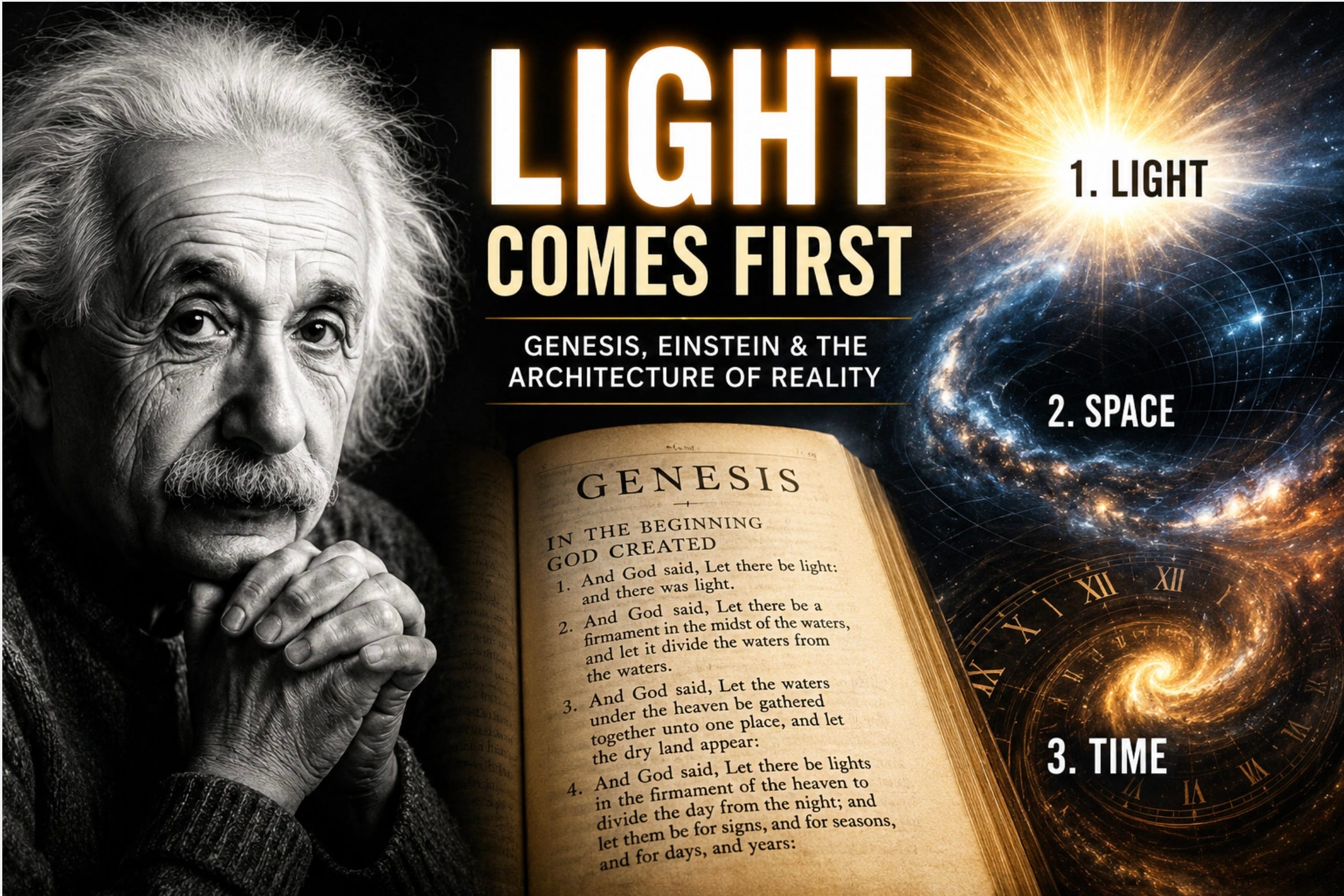
Just for the moment, Jesus’ claim to be the “Light of the world'“, instead of ‘space or time of the world’, takes on an added depth of power in the light of this exploration of Genesis and Einstein,
It was, oddly, the recent excitement about aliens that sent me back to Genesis. Some of my readers may remember how excited I got about the explanations that Professor Hannah Fry offered about the near impossibility of alien contact with us given the constraints of the speed of light and the enormous speed of the rise and fall of civilisations and their technologies.

What strikes anyone who takes the physics of those films seriously is the reminder of how punishing interstellar travel really is — not difficult, but categorically unaffordable.
The speed of light isn’t an inconvenience to be engineered around; it’s a wall built into the structure of the universe itself. Which is one honest answer to why we’ve never been visited: it isn’t necessarily that no one is out there, but even if there was, light itself sets the terms on which any journey across real distance can be made.
That thought carried me back to the opening page of Genesis, and to a sequence I’d read a hundred times without noticing its shape.
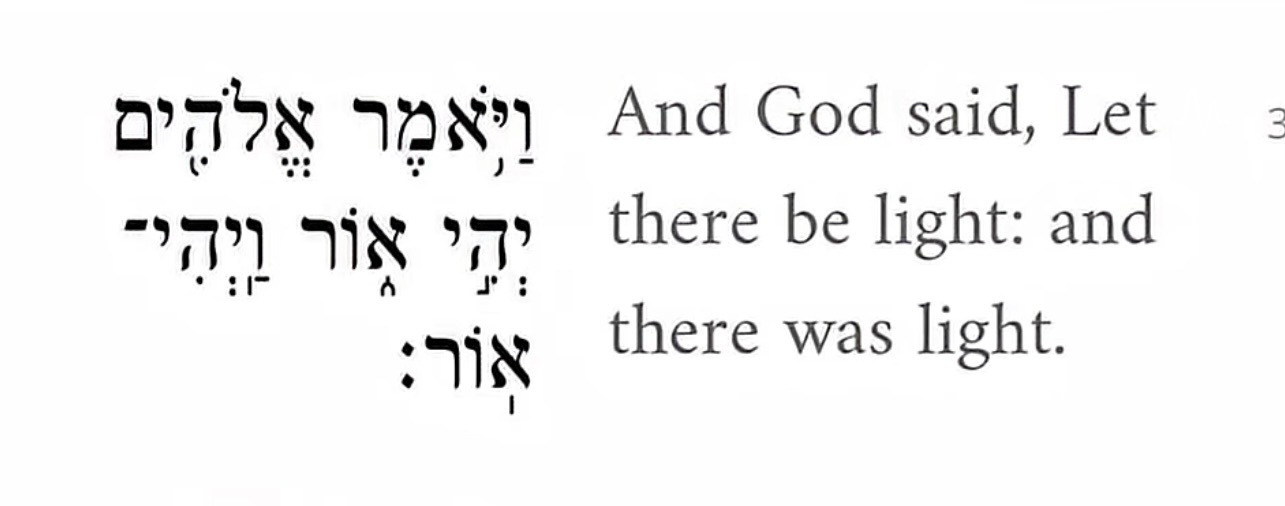
Day One: “Let there be light.”
Day Two, God parts the waters and creates space.
Day Four, God creates the sun and the moon, and the Torah tells us exactly what they are for: “for signs, and for seasons, and for days and years” — in other words, they are created to mark time.
Light first. Then space. Then time.
It is I think, not only a chronology but an architecture — and one that Einstein, three thousand years later and by an entirely different road, seems to have rediscovered.
What if Genesis isn’t simply giving us a chronological account of creation, but a conceptual one? What if it isn’t just telling us the order in which things happened, but the order in which they depend upon one another — the logical architecture of reality?
The very first piece of infrastructure God places into the universe is light. Everything else is built upon it. In some profound sense, light becomes the foundation from which our experience of space and time emerges.
Now here’s where it becomes seriously interesting. That is strikingly similar to what Einstein discovered in 1905 with his theory of special relativity. Until Einstein, scientists largely treated space and time as fixed and absolute — a second was a second, a mile was a mile. Einstein showed that this isn’t how the universe actually behaves. Time slows down as an object moves at extremely high speeds; distances contract; space and time are not fixed backgrounds but relative quantities. Why? Because the speed of light is constant. No matter how fast you travel, light is always measured at exactly the same speed in a vacuum. Since the speed of light never changes, something else has to give — and what gives is space and time themselves.
As the physicist John Archibald Wheeler put the underlying picture:
“matter tells spacetime how to curve, and spacetime tells matter how to move.”
Space, in other words, is not a stage but a participant.
The consequences run deeper still. If space and time are relative to the observer, then even the clean distinction between past, present and future starts to blur.
Einstein himself, writing to console the family of a friend, called that distinction
“only a stubbornly persistent illusion.”
St. Augustine had wrestled with the same mystery some fifteen centuries earlier in a famous passage from his Confessions, from the opposite direction — not through mathematics but through introspection:
“What, then, is time? If no one asks me, I know what it is. If I wish to explain it to him who asks me, I do not know. Yet I say with confidence that I know that if nothing passed away, there would be no past time; and if nothing were still coming, there would be no future time; and if there were nothing at all, there would be no present time."
(-St. Augustine, "Confessions" Book 11, Chapter XIV, 17)
Between them, the philosopher and the physicist bracket the same puzzle: time is the thing we live inside and cannot quite define, precisely because it is not, it turns out, a fixed thing at all.
I am not suggesting Moses taught Einstein’s physics, or that Genesis anticipated the Lorentz transformations. That would be a theological interpretation dressed up as a scientific one, and the claim I’m proposing is narrower, and more interesting for being narrower: that a text with no access to the mathematics of light nonetheless intuited that light belongs at the foundation of things — prior to, and different in kind from, the space and time that come after it.
