


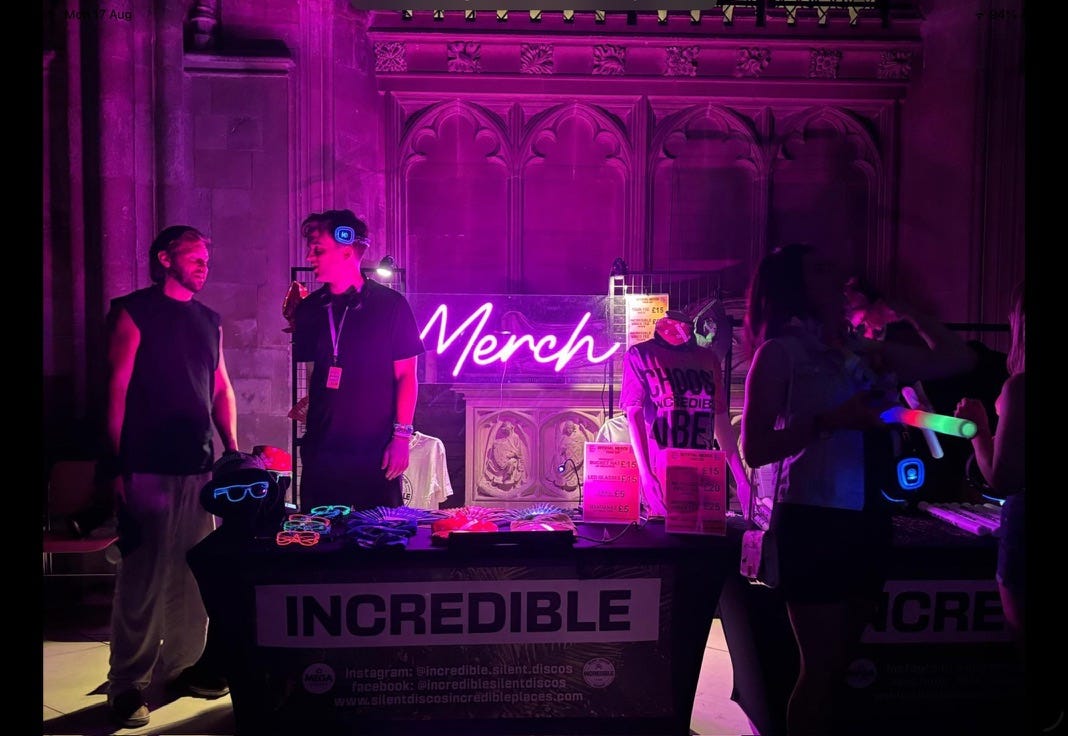
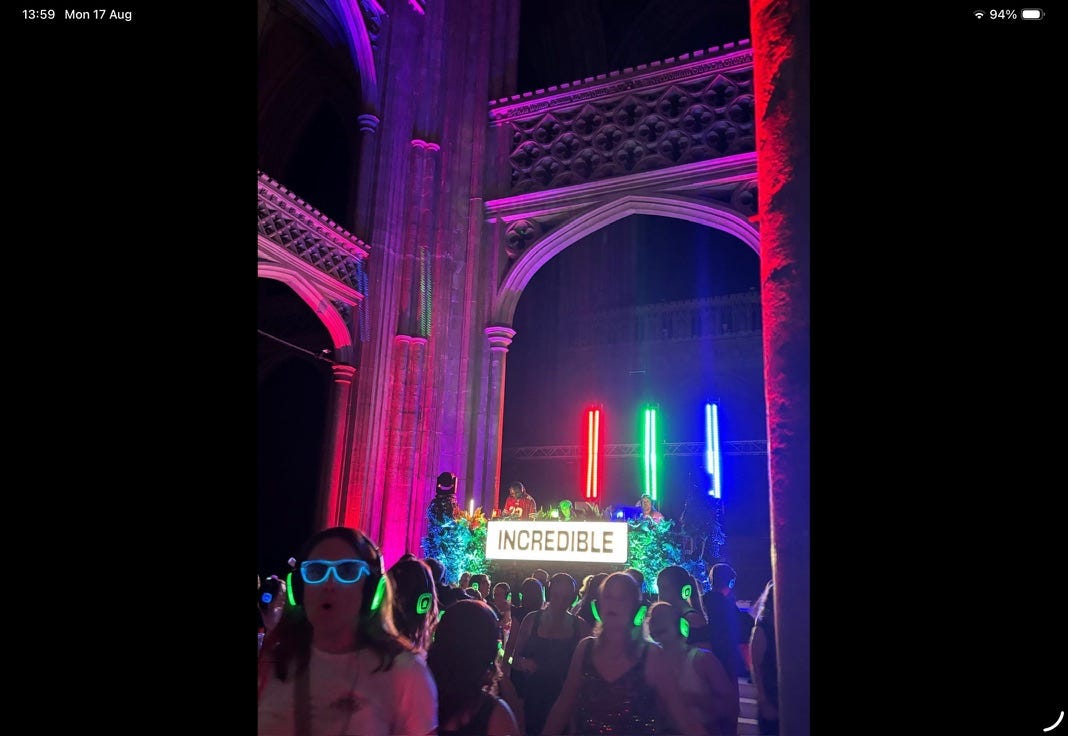
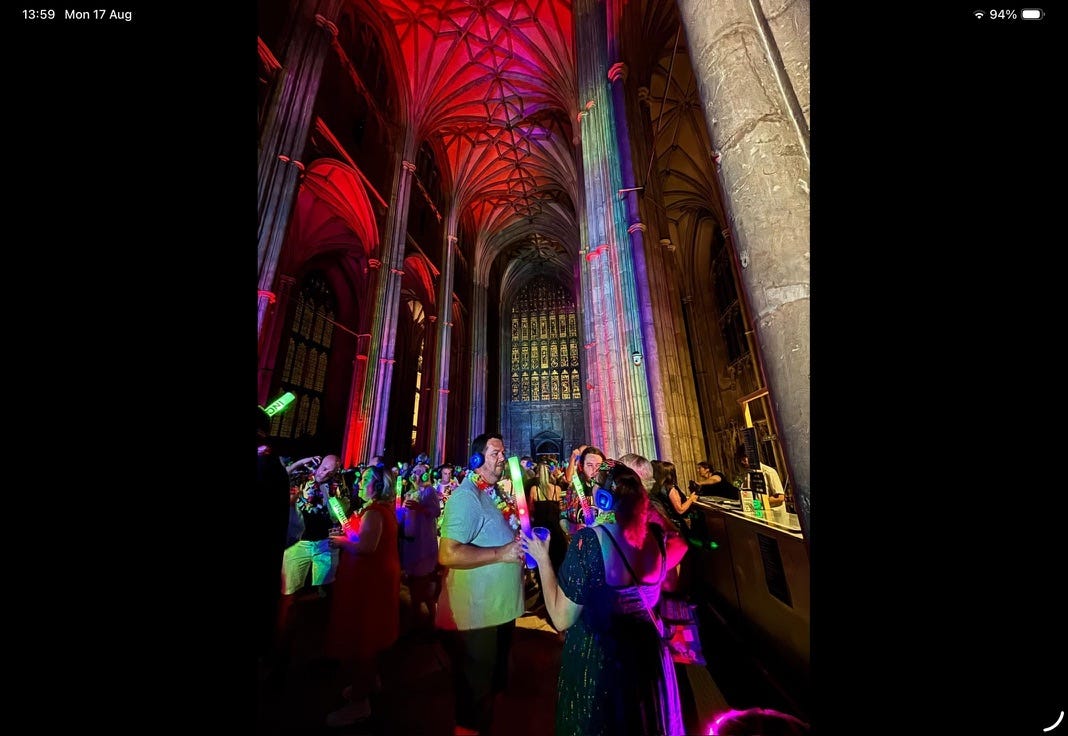
A few days ago, on the Feast of the Assumption of the Blessed Virgin Mary, the Dean of Canterbury unleashed his iconoclasm again and opened the cathedral to a Dionysian rave in the Nave.
How can we express the depth of our distress at this? Perhaps by imagining we were standing at the foot of the Cross during the Crucifixion, overwhelmed not only by love and adoration but also by complete misery and despair at the fate of Jesus on the cross. Only one thing could make it worse- mockery and castigation.
The disrespect and hatred added one more layer of horror to the physical torture.
DISRESPECT AND MOCKERY
And so, speaking of disrespect and mockery, when the Dean of Canterbury invited hedonistic dancers into the cathedral that Catholic imagination sculpted into being as an act of love and adoration, to raise money, to celebrate sex, promote self-expression and self-pleasuring through dance and the narcotics of rhythm, Catholics were horrified at the blatant disrespect and abuse of the sacred space dedicated to Jesus on the Cross and in the Blessed Sacrament.
The Protestant Dean shrugged and said he had no idea what sensibilities the Catholics were so upset about.
There have been a few online posts where Catholics have demanded that the Protestants who stole the cathedral should give it back, if they had no understanding of the purpose of a cathedral.
Protestants have, of course, denied that the state which outlawed and executed Catholics, and nationalised all its assets, actually ‘stole’ the buildings. They have to admit they neither conceived, built or understood them, but they claim they are ‘their’ cathedrals nonetheless.
That shows a level of historical ignorance and self-justification that is problematic
CATHOLIC IMAGINATION
Perhaps the best thing we can do is try to explain the Catholic vision and imagination that led to the building of a cathedral in the first place, just in case there is any chance at all that those Protestants committing, supporting or ignoring the blasphemy might catch a glimpse of the love of Jesus that lies at the heart of Catholic pain.
We need to begin with something subtle but important: the recognition that Catholics and Protestants have very different understanding of both time and space.
Let us start with time, because it is the simpler of the two.
Protestants often become very upset because they look at what Catholics do when they celebrate Mass and believe that it constitutes some form of repetition. That is because they have a mechanical and linear understanding of time.
To Catholics, this is very strange, and almost incomprehensible.
CATHOLIC TIME AND SPACE
The vision of heaven that the Book of the Apocalypse provides is outside time and space. So every time Mass is celebrated, what happens is not repetition but the invasion of time by eternity, providing us with a vision, a touch, a window, a pathway that frees us from the momentary claustrophobia of linear time by giving us, even now, a taste of eternity.
It is a mechanism or better an organism, for the redemption and invasion of time. Catholic liturgical time is cyclical and participatory: the Mass is understood to make the one sacrifice of Calvary genuinely present again, not merely to recall it psychologically, and the great cycle of saints’ days and feasts collapses the distance between the living and the dead, so that past and present interpenetrate rather than simply succeeding one another.
Protestant time, by contrast, tends to flatten into historical memory. Without a sacrifice re-presented and without the intercession of the saints, time stays essentially linear: the Supper commemorates something that happened once, in the past, and the building around it is a stage for present-day activity rather than a threshold where eternity intersects the everyday.
It is also a means of sculpting space
Protestants also have a very different understanding of space from Catholics. For them, matter is inert and a matter of usage. It is almost impossible to help them see more dimensions than the one.
MUSIC V THE TONE DEAF
The closest analogy is trying to explain music to the tone-deaf. To claim to them that Mozart has produced the most exquisite melodies, ones that pluck the heartstrings with ecstasy, lament and joy in only a few notes. All that happens is that they look at you and say, “I can only hear discord, noise and nothing else.”
Precisely because of our understanding of the sacraments, which flows from our understanding of the Incarnation, in which time and eternity are perfectly joined in the body of the Incarnate Word of God, a sacramental understanding of reality finds matter itself infused, almost inebriated, with spirit.
Matter ceases to be mere stuff. Instead, it becomes a living organism brought alive by the mind, imagination, purpose and Spirit of God, and crossing our experience of dimensions.
That is why, to the Catholic, stones can be holy. This is why Catholics celebrate relics - on the same principle, matter can be infused by holiness.
Matter becomes like a sponge that has soaked up love, prayer, adoration, yearning, longing, sacrifice and hope.
No stone in a cathedral is merely a piece of matter. Instead, it resonates. Like the sound post within a violin or a guitar, it amplifies and shivers with the music it was intended to carry.
Even without a sacramental worldview, at the level of pure symbolism alone, it is hard to understand how an Anglican establishment can contemplate feet being stamped in rhythmic pleasure upon stones once wet with the blood of a martyr in Christ’s name, where miracles that shook the known world with their frequency, drama and compassion, and where the stones had been worn smooth by generations of knees as people prostrated themselves before the living Christ in the Blessed Sacrament.
But such is the spiritual sterility and emptiness of the present custodians of this beautiful cathedral that nothing seems to count for more than their appetite for money, utility, convenience and spectacle.
Let us spend a few moments trying to understand something of the sanctified imagination that created the cathedral in the first place.
CATHOLIC VISION
It might have occurred to many of the readers of this platform to ask what thought had been given in the development of the Gothic imagination that had created so many of the most beautiful buildings human beings have ever constructed?
There were certain determinative ideas that came into play which helped create the idea of the Gothic Cathedral.
The first was that Stone and Space were never neutral. They could either be used in the service of rebellion or adoration. And if they were used in adoration, it would be because they had managed to capture beauty; and beauty in the eye would stimulate the hunger for beauty in the soul. So part of the purpose of the architecture of a Cathedral was to make the pilgrim draw breath in awe and allow a fusion of spirit and matter to enable the eyes to stimulate the brain to speak to the hunger of the heart and the soul, and so deepen the quest for God.
I think it’s a certainty that no Anglican Dean has ever heard of Abbot Suger,
Abbot Suger of Saint-Denis (d. 1151), wrote De Administratione and De Consecratione, texts that are effectively the founding texts of Gothic theological aesthetics. Suger describes rebuilding his abbey church so that light pouring through stained glass would lift the mind per materialia ad immaterialia — through material things to the immaterial. He's drawing on Pseudo-Dionysius the Areopagite (whom the medieval French wrongly conflated with their own patron St Denis), whose Celestial Hierarchy taught that visible beauty is the necessary ladder by which the mind ascends to invisible beauty.
He explicitly ties structural material beauty to our capacity for spiritual ascent.
Gothic ambition was never only aesthetic in our modern sense but set out to express theology in the language of stone, lines, space, light and glass.
Suger’s worldview was Neoplatonic, filtered through Pseudo-Dionysius, whom Suger believed (mistakenly, but sincerely) was the same Dionysius who founded his own abbey.
Dionysius's Celestial Hierarchy argued that the human mind, being embedded in matter, cannot leap straight to contemplating pure spirit — it needs "material lights" as a ladder. Suger took that literally. Over the west doors of his rebuilt church he had inscribed the idea that the dull mind rises to the truth through material things, and that seeing this light lifts it out of its former submersion.
Gothic architecture insists the beauty of building things rightly ordered is exactly where the sacred chooses to be found. It was later argued that the structural clarity of Gothic engineering, everything visibly doing its logical work, nothing hidden, mirrored the scholastic Passion for making every step of an argument in theology visible and accountable. Form and theology were moving together in the creation of the Gothic Cathedral.
RELICS - UNDERNEATH THE ALTAR
The altar as literal reliquary — a canonical fact, not a metaphor
This goes back to the earliest centuries. During the persecutions, Christians in Rome frequently celebrated the Eucharist on or near the tombs of martyrs in the catacombs — the martyr’s body sanctified the meeting place, and the practice hardened into settled custom. Tradition read Revelation 6:9 as scriptural warrant for this: John’s vision of the souls of the slain “underneath the altar.” By the time of the Second Council of Nicaea in 787, this custom had become canon law: a church could not be validly consecrated without relics placed within or beneath its altar. That requirement persisted in the West for the whole medieval period and, in modified form, remains in Catholic canon law today for fixed altars. This is why “reliquary” isn’t a poetic flourish applied to a cathedral from outside — a properly consecrated cathedral altar is, as a plain matter of ecclesiastical law, a sealed container of human bone. The altar slab is called the mensa, the table, but it sits over what is functionally a tomb. Table and tomb are fused in the same stone: sacrifice and martyrdom, Eucharist and relic, occupying the identical few inches of masonry.
Why bones specifically — the theological logic
The cult of relics isn’t reverence for the object as object; the Church has always been emphatic that venerating a bone is not the same as worshipping it, on pain of idolatry. The logic runs through the doctrine of the resurrection of the body. A saint’s remains are honoured because the Holy Spirit indwelt that particular body during a particular life of grace, and because that body itself awaits its own resurrection — it isn’t inert matter but matter with a specific, unfinished sacred history attached to it. Matter is capable of bearing sanctity because of what has actually happened within it, not despite being matter. A relic is proof, in bone, that a particular human life was genuinely taken up into holiness.
WHY THE MASS IS THE KEY TO EVERYTHING. A RELIQUARY AND A MONSTRANCE
The Blessed Sacrament — a different order of presence entirely
A relic points backwards: this person lived and died in grace, and their remains are a pledge of a resurrection still to come. The Blessed Sacrament is not a relic of anyone past at all — it is held to be the substantial, living presence of Christ himself, not commemorated but actually there, re-actualised at every Mass and then reserved continuously in the tabernacle.
So strictly speaking, calling the tabernacle a “reliquary” is analogy rather than identity — but it’s an analogy the medieval mind pushed hard, precisely because pyxes and monstrances were built using the same goldsmith’s vocabulary as bone-reliquaries. The two systems run in parallel: the altar houses the particular, backwards-looking sanctity of the martyrs; the tabernacle houses the perpetual, ongoing sanctity of Christ himself. The cathedral then becomes a magnificent monstrance. A great cathedral typically has both simultaneously — high altar and side-chapel altars each sealed with their own martyrs’ bones, crypt and treasury often holding still further major relics, and a tabernacle at the centre holding something categorically greater than any of them.
CATHOLICS VERSUS PROTESTANTS:
For Catholic theology, space then is capable of a genuine change of state. Consecration is not a ceremony that marks a change of use, the way flying a flag over a building marks a change of ownership. It is understood to effect something real: the altar, the walls, the ground itself become a locus where the sacred is objectively present, not merely a place where a community has agreed to behave as though it were. This rests on a sacramental view of matter running through the whole Catholic system — the conviction, worked out across seven sacraments, that physical things are capable of bearing and transmitting grace rather than simply symbolising it from a safe inert distance.
It reaches its sharpest point in the doctrine of transubstantiation: the substance of bread and wine is held actually to change, so that the tabernacle is not a reminder of Christ but the place where he is.
Once a building is organised around a locus of Real Presence in this strong sense, the building itself is drawn into that same ontology.
This is the seed from which the whole reliquary image of this essay grows: a church built around a Real Presence naturally comes, over centuries, to be shaped like a vessel built to house one.
ANGLICAN REPUDIATION
The Reformers broke this link, and did so deliberately. Zwingli read Christ’s words at the Last Supper as figurative, making the Eucharist a memorial act performed by the gathered community rather than a sacrifice re-presented in their midst. Calvin held a more mediating position, teaching a real but spiritual feeding by the Holy Spirit, but he too rejected any local, substantial presence tied to the elements or to the place where they were consecrated.
The Church of England inherited this Reformed instinct more thoroughly than its surviving Catholic architecture and much of its liturgical form would suggest: Article XXVIII of the Thirty-Nine Articles explicitly denies transubstantiation. It’s in the DNA of Anglican self-understanding. All clergy have to swear an oath of assent to it as a condition of being ordained into the Anglican Church.
If nothing objectively happens to the bread and wine, nothing objectively happens to the building that houses them either. A church becomes, theologically, a meeting-house — sanctified by association, memory and habit, not by any change in what it is.
The great iconoclastic campaigns that followed the Reformation, the whitewashing of walls and smashing of images, were not just philistinism. They were also a new and divergent theology being applied with ruthless consistency to buildings that could no longer, on the new view, be anything other than useful shelters for a gathered congregation. Everything else had to be destroyed.
THE NEW ICONOCLASTS
Let’s go back, for a moment, to the sixteenth century, and watch what the first iconoclasts actually did. They pulled the rood screens down with ropes. They smashed the faces off the saints in the west front. They whitewashed the Doom paintings over the chancel arch, scraped the gilding from the reredos, melted the reliquaries down for their metal and scattered what they had contained. It was violent, visible, and — on its own terms — entirely coherent.
If nothing objective happens at an altar, if a bone is just a bone and a painted board just paint, then all that ornament is not neutral clutter to be tidied away. It is a lie, actively misleading the faithful into venerating what deserves no veneration, and a serious reformer has a positive duty to destroy it. Say what you like about the men who did this: they understood exactly what they were attacking, and why it had to be attacked with hammers.
The Dean of Canterbury does not own a hammer, and doesn’t need one.
He inherited a cathedral whose fabric his own communion no longer possessed the theological equipment to explain, and rather than smash the holiness out of the stone, he simply stopped insisting the stone had ever had any.
But he has done something more insidious and subtle. He has embarked on a policy of desecration. Instead of smashing the stone, he has gone for the desecration of the spirit and the holiness, which in my judgement is worse. He is polluting the place with a different spirit, that of Dionysius, the pagan god of sex and dance.
That is the more advanced and toxic form of the same operation. The sixteenth-century iconoclast believed the images were false and dangerous and moved to destroy them; the modern iconoclast does not need to believe the images are false, because he has already stopped asking whether they are true or false at all.
