


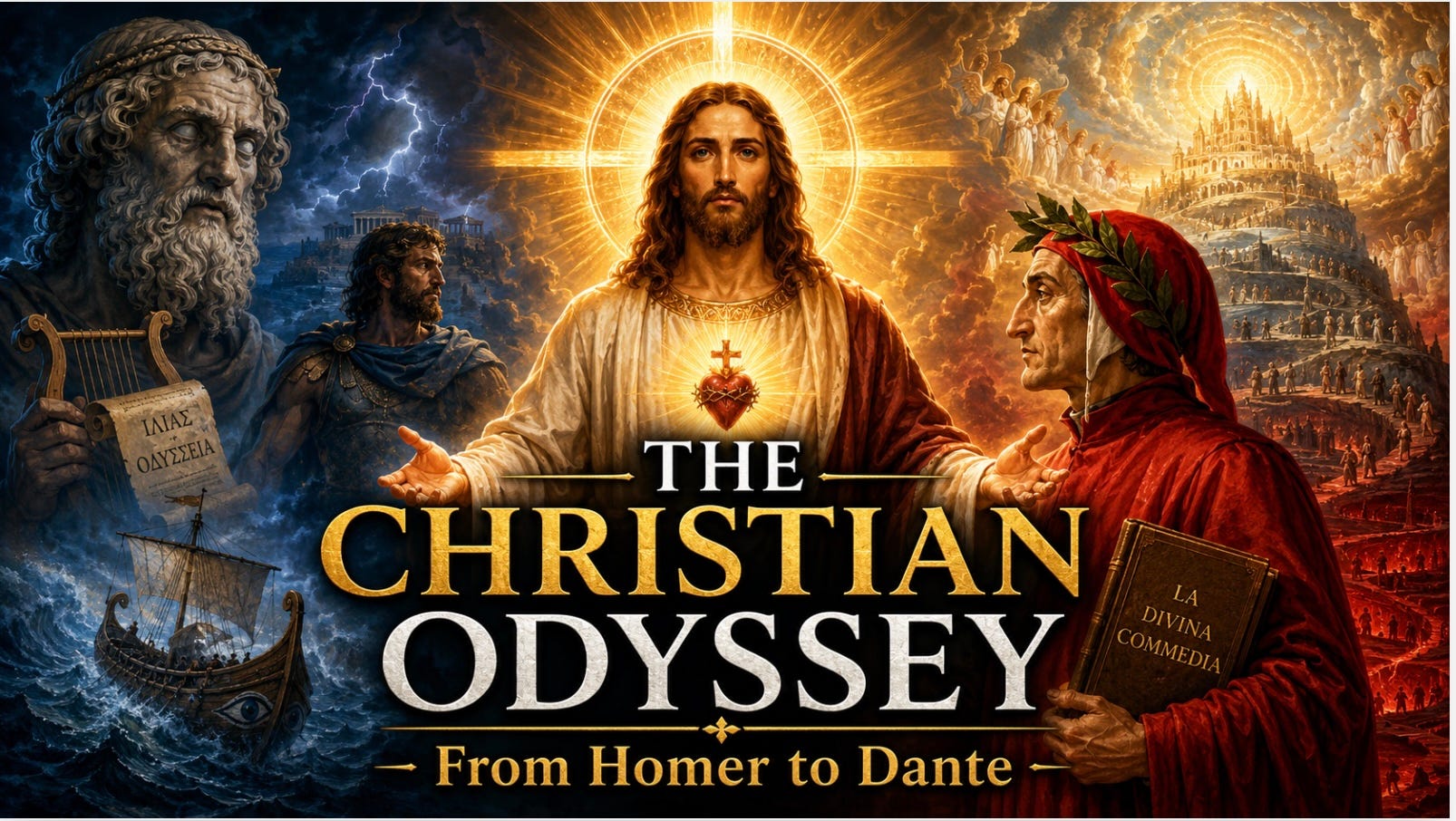
Introduction
Dear readers,
Christopher Nolan has re-introduced Homer to our culture. Critics are arguing about the merits of the film as a representation of the book. Let them, something more important is at stake here. It seems to me an opportunity to introduce people who need an archetypal hero, (Odysseus) to the need for both a hero and a universal saviour, - Jesus.
Many of you will know I am a sucker for a chiasm. I see them often, and in such strategic places. But Jesus loved them too - as the Lord’s prayer, the most beautiful and effective chiasm, demonstrated. I see a very powerful chiasm here bestriding our cultural history, of which more below.
I am also fond of natural theology. I like seeing the Holy Spirit working at first anonymously, slipping ‘stuff’ in forms that excite the mind and appetite, slipping it behind our guard- under our radar, and then, at the right moment, jumping out in front of us to surprise us, and disclosing to us that ‘it was always about Jesus.’
I read Homer and the Odyssey as a child. I think in an abbreviated format.
So here now, decades later, the excitement of the boy, as I was, immersed in myth and wild adventure, comes to fruition in the man - near the end of his life; a man who has been (as we all have been, like Odysseus,) on his own quests, and failed just as spectacularly as Odysseus, but with perhaps with less glamour.
The difference is that since then, and since Odysseus, I have discovered Jesus. And a further difference is that where Odysseus charmed, alarmed, delighted, inspired and terrified me, Jesus does all that, but also rescues me. Even as a boy I knew I needed a rescuer. As a man, teetering on the brink of so much failure, and the sharp edge of mortality, I know it may be all that actually matters.
So here, in microcosm, is both my story and everymans’ (ok - and womans’ of course).
I have not been thinking about Homer for a while, though I have never stopped thinking about Plato (his mental interpreter, who moved story to idea.)
And I have found a more natural home in Dante, than I ever did in Homer (whose world was terrifyingly brutal). So I was hugely excited when coming back to Homer through this new rather weird film, I realised that of course, Dante (andAugustine) were Homer (and Plato) with Jesus as the new, better and very much improved Odysseus.
Here is the chiastic structure bit:- AND - it all fits into a chiasm.
I find this all very exciting and satisfying. I hope you might too. Because, we still have to get to heaven, and the world we live in has failed to many its passions, order, and need for justice and identity.
‘Phone Home’
Western civilisation can be read, in one sense, as the story of a journey home. Homer gives the journey its first great narrative form. Plato turned adventure into idea and conceived the patterns of its philosophical architecture. Christ bursts into time and space, the new and ultimate hero, entered the pattern, fulfilled it, and changed it and us into something so much better.
Augustine did a Plato for us, and explained and described what that change meant inside the human soul.
And Dante, at the far end of the tradition, re-writes the Christian world a new and much improved odyssey with a clearer and more wonderful picture of home.
The Chaism
If we lay these five elements out, they fall into a shape almost too neat to be accidental — a chiasm, with Christ at the hinge:
Homer narrates the journey. Plato reveals its order. Christ becomes the Way. Augustine explains how grace remakes the traveller. Dante narrates the journey again, this time for Christendom.
It opens and closes in poetry. The Greeks knew that we needed poetry to really learn and become educated. Poetry is the raw intense mediation of wisdom.
Between Homer and Dante stand Plato and Augustine — the two great interpreters of the soul’s order, one pagan, one Christian. But the centre belongs to neither poet nor philosopher. At the centre is Christ, and he is there not as one more voice explaining the journey, but as the Word upon which all poetry, (words) are predicated, and as the event that changes what the journey is.
Homer and the Human Journey Home
The Odyssey is an adventure story. But it is so more than a magnificent adventure story. It’s an account of how order gets restored to a world that has come apart.
Odysseus wants to reach Ithaca, but his homecoming was never simply geographical.
He has to recover his identity, his marriage, his household, his kingship, his standing with the gods — and before any of that, he has to recover command of himself. The journey runs outward and inward, a dynamic that is both exterior and interior, simultaneously.
The monsters he meets aren’t just obstacles in his path. Christians will recognise them as demons. Each one names a way that human identity comes apart: the Lotus-Eaters offer forgetfulness, Circe threatens to reduce men to beasts, the Sirens tempt with knowledge stripped of wisdom, Calypso offers pleasure and (pseudo)-immortality in exchange for responsibility, Scylla and Charybdis force him to choose between two irreducible losses. Every episode is asking the same question in a different key: what will you give up to avoid the difficulty of being yourself?
He learns, slowly and at cost, that getting home takes more than strength. Ajax is stronger than he is. Achilles is so much more glorious. Neither of them gets to Ithaca. Odysseus does; through prudence, patience, endurance, self-command, and the long, humiliating education of his own passions.
Homer’s real insight, though, is that disorder in the soul never stays private. (We Christians have been trying to tell our secular hedonist neighbours this for decades now, but they won’t listen. They are too busy trying to have sex to read either Homer or the Gospels.)
It moves into the household. It corrupts marriage. It corrodes religion. Eventually it wrecks the political order too. The suitors show the whole progression: men who cannot govern their own appetites become men who cannot respect hospitality, or property, or marriage, or kingship, or the gods. Their gluttony isn’t a private failing that happens to be distasteful, by the time Odysseus returns, it has become an assault on Ithaca itself.
Anarchy in the soul has produced anarchy in the state.
So Odysseus’s return restores an entire moral ecology, not just a marriage or a throne. He comes back as husband, father, king, and worshipper together, and it’s the recovery of his own selfhood that makes the rest possible. The Greek word for this is nostos — homecoming — but Homer stretches the word until it means something closer to: the recovery of the self, and of the world that self properly belongs to.
Odysseus, Both Is and Is Not, Jesus
There’s a real sense in which Odysseus anticipates Christ. This needs to be put carefully, because it’s easy to overstate.
Odysseus is no hidden Christian saviour — he’s morally compromised, often deceptive, sometimes cruel, and utterly dependent on a wisdom greater than his own. He belongs fully to the pagan heroic world and never leaves it.
And yet the pattern is there, waiting to be fulfilled by something it cannot produce on its own. As Jung would put it, accurately for once, he is the archetypal ‘hero’. Odysseus is the pioneer of the journey home: he goes into danger, faces down the passions, descends toward the world of the dead, endures what has to be endured, recovers who he is, and comes back to reclaim a kingdom that has fallen into disorder. He is natural man at his best — wounded, fallible, incomplete, but still fighting his way toward order rather than surrendering to chaos. He tells us that human life has the shape of a quest, that we are estranged from our true home, and that finding our way back will cost us courage, sacrifice, wisdom, and self-command.
In that sense Odysseus is proto-Christological. He discloses the pattern: descent, trial, confrontation, return.
But he cannot complete it. Odysseus can restore one man, one marriage, one household, one kingdom — and that’s the ceiling. His wisdom stays his own. His suffering may qualify him to rule Ithaca, but it can’t reach into the sufferings of people not yet born and redeem them from within. We can admire him, imitate him, learn from him. We cannot participate in his life. He can discover the road home. He cannot become the road. He cannot and does not save us.
We Need Rescuing
That’s exactly where the contrast with Christ turns decisive.
Christ doesn’t simply run the heroic quest better than Odysseus did.
He changes its nature, because he has something Odysseus never could: the life of God himself.
Odysseus travels inside a universe whose full meaning is hidden from him; Christ is the Word through whom that universe was made.
Odysseus struggles for years to recover his identity; Christ gives us a new one in himself.
Odysseus restores his household; Christ founds a new household made of grace rather than blood.
Odysseus wins back a single, temporal kingdom; Christ opens a kingdom that can enter every nation, culture, and human heart there is.
Odysseus goes down among the dead and comes back with knowledge; Christ goes down into death and breaks it from the inside.
Odysseus offers sacrifice to repair his standing with the gods; Christ is the sacrifice that reconciles humanity to God.
Odysseus finds the pattern. Christ is the pattern and draws us in.
Plato maps what Homer narrates
Plato takes the moral and spiritual structure buried inside Homer and pulls it up into daylight as argument. So Homer gives us the journey; and Plato gives us its map.
Odysseus’s homecoming becomes, in Plato, the ordering of the soul.
The restoration of Ithaca becomes the just city.
Telemachus’s coming-of-age becomes the education of the young.
Odysseus’s hard-won kingship becomes the rule of the philosopher-king.
Where Homer shows the passions being schooled through suffering and trial, Plato sits down and analyses the actual relationship between reason, spirit, and appetite.
Justice, on Plato’s account, isn’t obedience to rules handed down from outside. It’s
right relationship,
right hierarchy:
appetite governed by reason,
courage placed in the service of wisdom,
every part of the soul oriented toward the Good.
Homer makes us travel through the soul. Plato conceives the architecture of the country we’ve just walked across.
The Gap
But Plato leaves us with a genuine problem, and it’s worth sitting with it rather than rushing past. Understanding the structure of a rightly ordered soul is one thing. Becoming rightly ordered is another.
The intellect can see the Good perfectly well while the will simply refuses to choose it — the map can point out the road without giving the traveller the legs to walk it. Knowing the route isn’t the same as being able to travel it.
Which brings us thankfully to our bridge-man. And it also gives me the opportunity to share why I am prone to call myself a neo-platonist (‘sucker for Plotinus’)
Plotinus and the metaphysical homecoming
Plotinus takes the Platonic vision and turns it into an explicitly spiritual drama of departure and return. The soul, on his account, has descended into multiplicity, fragmentation, distraction — and its whole vocation is to return to its source, turning inward, climbing back up through the intellect, seeking union with the One.
The Homeric homecoming has become metaphysical. We can trace the whole arc in three moves: Homer presents homecoming as the restoration of a human life; Plato presents it as the ordering of a soul; Plotinus presents it as the soul’s return to the transcendent source of being itself.
Neoplatonism hands Christianity a genuinely inspiring and accessible architecture of ascent. But notice the direction of travel here: the movement is still, fundamentally, upward. The soul climbs toward the divine. Christianity starts by reversing the direction of travel. God descends. The divine doesn’t wait at the summit for the purified mind to arrive — the eternal Word enters flesh, history, vulnerability, suffering, and death. This single reversal is what changes the DNA of the whole journey.
And thence to our beloved St Augustine:
Augustine and the Missing Centre
Augustine, as I discovered with huge excitement, is the hinge between the Platonic ascent and the Christian odyssey, and he was only too aware of it. He’d read the Platonists closely enough to recognise both their greatness and the hole at the centre of them.
Among the Platonists, he writes in the Confessions, he found a great deal about the eternal Word —
“not indeed in these words, but to the same effect... that in the beginning was the Word, and the Word was with God, and the Word was God.”
What he did not find there was the one thing Christianity actually rests on. “But that the Word was made flesh, and dwelt among us,” he says plainly, “I read not there.” The Platonists could point him toward the homeland. They could turn his gaze toward the height he’d fallen from. What they couldn’t do was heal his will, or give him the strength to climb.
That turns out to be Augustine’s real discovery: the human problem runs deeper than ignorance. Seeing the Good isn’t enough. The will itself is split against itself — this is the whole argument of the Confessions, dramatised in the famous scene in the garden at Milan where Augustine wants to give himself to God and finds that some other, older part of him won’t let go. Desire is disordered before it is ever instructed. The traveller doesn’t need better directions. He needs to be healed. He needs to be saved.
“Thou hast made us for Thyself, O Lord,”
Augustine writes at the very opening of the Confessions,
“and our heart is restless until it repose in Thee.”
Restlessness, not ignorance, is the deeper diagnosis, and no philosophy, however lucid, cures restlessness by argument. Plato can show the soul the order it ought to have. He cannot supply the life by which that order becomes possible. Augustine finds that missing power only in grace:
“Late have I loved Thee,” he confesses near the end of the book, “O Beauty so ancient and so new, late have I loved Thee! For behold Thou were within me, and I outside; and I sought Thee outside.”
Plotinus gives us the ladder. Augustine discovers that fallen humanity is too wounded to climb it, and that wonderfully and salvifically, God has therefore climbed down.
That gives us a second pairing to set beside the first. Homer narrates moral order; Plato makes its structure explicit. Christ accomplishes redemption; Augustine makes the inner structure of grace, desire, and conversion explicit. The parallel isn’t exact, though, and we need to acknowledge why.
Homer is the poet behind a story Plato can analyse from outside. Christ isn’t the poet of Christianity — he’s its incarnate centre, the thing itself rather than an account of the thing. Augustine isn’t doing to Christ what Plato did to Homer; he’s contemplating and interpreting a reality Christ has already accomplished. Put plainly: Plato maps the order Homer narrates. Augustine maps the grace Christ communicates.
The Incarnation Transforms the Odyssey
The Incarnation doesn’t just tack a religious ending onto the classical journey. It rewrites the whole pattern.
The classical movement runs from below to above, from multiplicity toward unity, from passion toward reason, from the material toward the spiritual.
Christianity begins somewhere else entirely: with divine descent.
The Word becomes flesh. The Creator enters his own creation. The immortal takes on mortality. God assumes the wounded human condition, carries it all the way through death, and raises it into resurrection. The Christian odyssey therefore takes the shape of Christ himself — descent, self-emptying, obedience, suffering, death, resurrection, exaltation.
This changes the classical journey in ways that are easy to state and hard to overstate.
The body is redeemed rather than discarded.
The passions are healed and converted rather than merely suppressed. Desire is redirected rather than extinguished.
Home is no longer just the recovery of what humanity once had — it’s entry into something greater, participation in the actual life of God.
The Christian nostos doesn’t return us to Eden; in Christ, human nature is carried past Eden into communion with the Trinity.
And the hero is no longer, first of all, the one who seeks. He is the one who is sought. That’s the paradigm shift underneath everything else here: humanity’s search for God gives way to God’s search for humanity, and we go looking for God at all only because he came looking for us first.
Dante, the Christian Homer
Dante does for Christendom what Homer did for the Greeks. He takes the moral, philosophical, and theological inheritance of his civilisation and gives it a body to walk through. He doesn’t merely explain the Christian doctrines of sin, judgment, purification, grace, and beatitude — he makes us travel through them, canto by canto, the way Odysseus’s listeners travelled with him from island to island.
The Divine Comedy opens on ground Homer would recognise instantly: a man who has lost his way.
Midway upon the journey of our life I found myself within a forest dark, For the straightforward pathway had been lost.
