

A conversation with a 'philosopher exorcist': Gavin talks to Fr Carlos Martins of the Exorcist Files.
A conversation about the reality of evil, the nature of angels, conversion, power, time, rebellion and salvation,
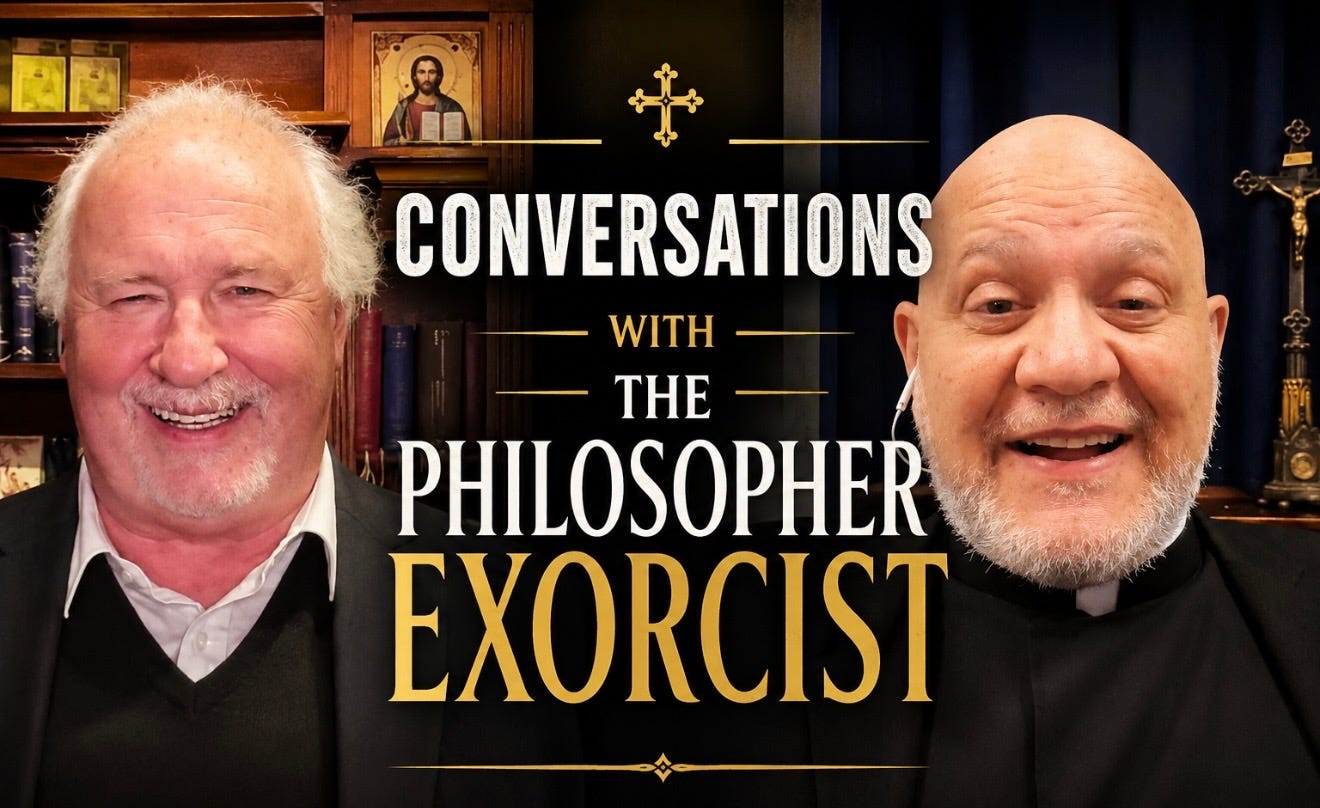
Conversations with the Philosopher Exorcist
From atheism to eucharistic adoration, and from philosophy lecturer to confronting the demonic
There are some conversations that stay with you because they cross so many boundaries. They carry a different kind of weight. They touch the borderlands
between philosophy, psychology, mysticism, suffering and grace.
This interview was one of them.
What struck me most was not sensationalism. Quite the reverse. It was the calmness, rationality and extraordinary clarity with which this Fr Carlos Martins, once a philosopher but now an exorcist, described his journey from atheism to faith.
He began not as a credulous religious enthusiast, but as a convinced philosophical atheist. He had examined religion seriously, found the arguments for God wanting, encountered God in Eucharistic adoration, and discovered that the universe itself disproved the existence of a loving Creator.
And yet, through an encounter with Christian peace — not argument first, but peace — everything changed.
What follows is an edited and formatted summary of our conversation.
The full video of the conversation is accessible at the end of this script.
“If God exists, why does He hide Himself?”
Gavin Ashenden:
Please tell us how it was that you began as an atheist, became a Christian, then a Catholic, then a priest, and eventually an exorcist. Can you tell us a little about that journey?
Exorcist:
I was baptised as an infant into a nominally Catholic family, but we were not practising. As I developed intellectually, I became convinced that God could not exist.
For me, there were three central arguments.
First: if God exists, why are there so many contradictory religions?
Second: if God exists, why is there so much evil? Why can an innocent child be kidnapped and murdered?
And third — this was the big one for me — if God exists, why does He hide Himself?
Why does He not simply reveal Himself plainly? Why must faith be required at all?
Those arguments convinced me that an all-good, all-loving God could not exist.
But I didn’t celebrate atheism. I respected it intellectually, but it brought no joy. Because if God does not exist, then neither does eternity. Human life collapses into matter in motion. Once consciousness ceases, there is no “you” left even to know you are dead.
And eventually, a hundred years after your death, once everyone who knew you is gone, it is as though you never existed at all.
The Christians who disturbed his atheism
The turning point came through university friends.
Not emotionalists. Not fools.
Intelligent Christians.
And what unsettled him was not simply that they believed — but that they possessed something he lacked entirely.
Peace.
He recalled sitting with one of them in a campus coffee shop when someone arrived to announce that his friend’s car had been stolen, wrecked, and smashed into a tree.
The Christian simply turned and replied:
“Well, I guess it just wasn’t God’s will for me to have a car right now.”
Then he calmly carried on drinking his coffee.
The exorcist told me this moment stunned him more than any argument.
He realised these people inhabited reality differently.
“I’ll bring the beer”
Eventually he was invited on a Christian retreat.
He misunderstood the word “retreat” entirely.
“I heard retreat,” he laughed, “and understood vacation. So I said, ‘Deal — I’ll bring the beer.’”
Only after arriving did he realise he had accidentally signed up for a Eucharistic adoration retreat.
Worse still, this was the mid-1990s before mobile phones. Escape would not be easy.
There were six men covering twenty-four-hour adoration in shifts.
And there he sat, an atheist, staring at what appeared to him to be “a cracker”.
Finally, trapped between embarrassment and honesty, he did something utterly simple.
He knelt down and prayed.
“God, I don’t believe You are here.
But if You are — if You exist — reveal Yourself to me.
And if You give me what I see in these people, I’ll give You my life.”
The thread of peace
What happened next was not dramatic in the cinematic sense.
No visions.
No voices.
No ecstatic spectacle.
Instead, he described “a thread of peace”.
At first very faint.
Then stronger.
By the second shift it had become “a string”.
By the third — at 3 a.m. — something changed entirely.
He entered the chapel an atheist.
He left it a believer.
Not because of argument, but because of an overwhelming certainty that he stood in the presence of God.
He was careful in how he described it:
“Peace is the one thing that cannot be faked.
It is the one thing madness cannot counterfeit indefinitely.”
And perhaps most importantly:
“I never again had a doubt about God’s existence.”
Faith and covenant
One of the most profound moments in the conversation concerned the nature of faith itself.
He argued that many people “investigate” God while carefully remaining in control.
They place themselves above God as examiner, demanding proof while remaining personally untouched.
But the prayer that changed his life was covenantal.
It involved surrender.
Not merely curiosity.
He put it this way:
“Have you ever asked God to reveal Himself to you in a way worthy of the divine being?”
That distinction matters enormously.
Because modern people often ask for evidence while reserving the right never to change.
But revelation, by its nature, changes everything.
The danger of religion without mystery
The conversation then turned toward theology, seminary formation and the modern Church.
One of the striking themes was his conviction that attempts to make Christianity “reasonable” by stripping away mystery actually destroy it.
He argued that much modern theology has tried to sanitise the supernatural:
reduce religion to ethics,
community building,
humanitarianism,
social concern,
and psychological wellbeing.
But in doing so, it quietly evacuates transcendence.
He put it starkly:
“You can’t hear Jesus Christ in them at all.”
And then came the devastating observation:
“What on earth do empty churches have to teach us about evangelisation?”
It was impossible not to hear the contrast he was drawing between flourishing Christianity in parts of Africa and exhausted progressive ecclesiastical cultures in Europe.
The psychology question
One of the most difficult areas we discussed was the overlap between spiritual phenomena and mental illness.
Since Freud, modern culture has often assumed that religious experience is merely pathology under another name.
But exorcists are forced to work precisely on that border.
The first question an exorcist asks, he explained, is not:
“Is this demonic?”
But rather:
Is this schizophrenia?
trauma?
delusion?
attention-seeking?
psychological collapse?
or something genuinely preternatural?
And the Church itself insists on this caution.
He described listening carefully not only to the person, but also to his own spiritual discernment while evaluating cases.
